
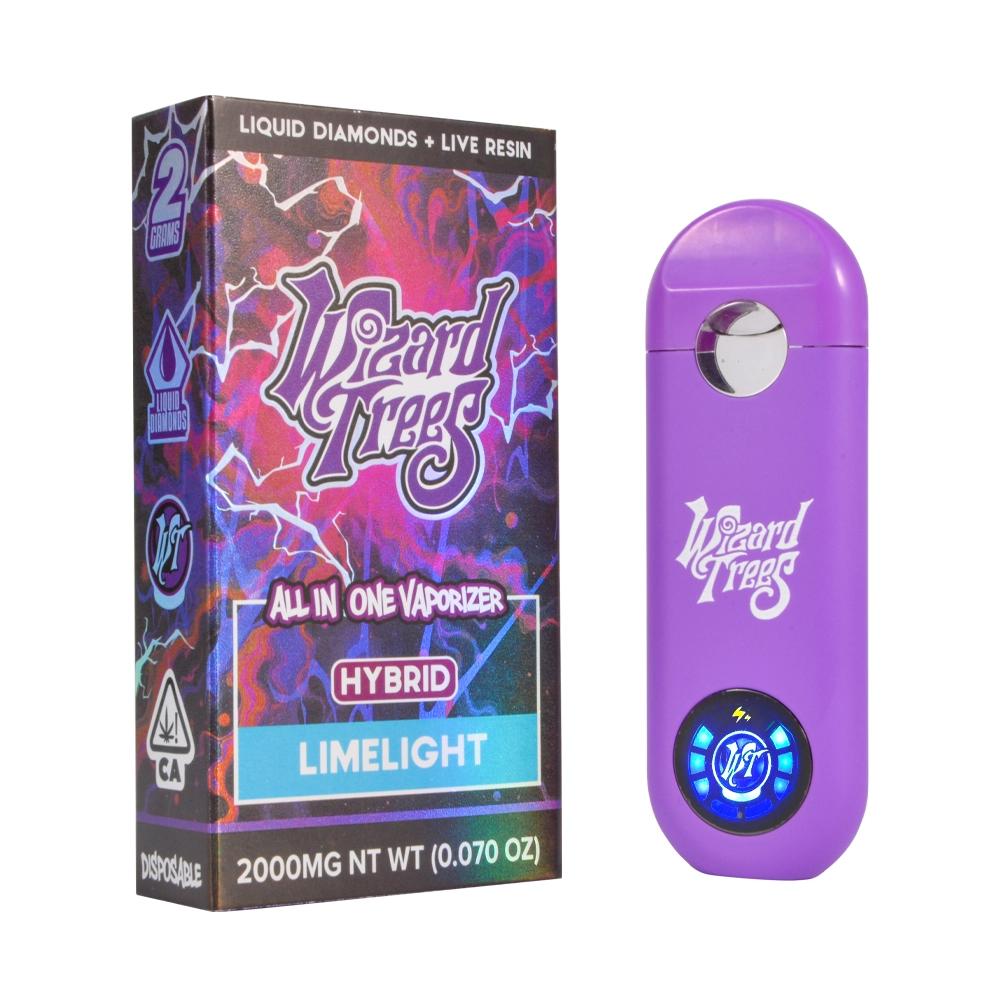
Wizard Trees Disposable Specs Explained: 1.0ml vs 2.0ml, LED Battery Display & Type-C Charging
Scope (B2B / empty only): This guide focuses on empty, unfilled disposable hardware that’s commonly marketed with “Wizard Trees” branding in the wholesale/OEM channel. The official Wizard Trees site is primarily brand/flower-focused and does not publish a standardized disposable hardware spec sheet—so for procurement, you should treat hardware specs as supplier + batch specific and lock them down via samples and PO controls.
1) What “Wizard Trees Disposable” usually refers to in wholesale hardware
In the B2B hardware market, “Wizard Trees” often appears as a branding theme / packaging set attached to an all-in-one disposable platform sold by manufacturing/packaging suppliers. One current wholesale listing positions it as an “All-in-One Vaporizer” platform offered in 1.0ml (1000mg) and 2.0ml (2000mg) options, with a base display and Type-C charging.
Buyer implication: don’t assume there’s only one “real” version. Your job is to define your version (capacity, display behavior, charging expectations, packaging) and ensure every shipment matches it.
2) 1.0ml vs 2.0ml: choosing the right capacity for your SKU strategy
The spec difference
A common way suppliers define the platform is dual capacity availability: 1.0ml (1000mg) and 2.0ml (2000mg).
The business difference (how to choose)
Pick 1.0ml when you want:
-
Lower unit cost and lighter cartons (often better for test launches and multi-SKU assortments)
-
Faster inventory turns and simpler QC sampling for new suppliers
Pick 2.0ml when you want:
-
Fewer unit swaps for end users (better “long-session” positioning)
-
Higher perceived value per unit (useful for premium shelf presentation)
What to lock in before you scale
Even when “1.0ml vs 2.0ml” looks straightforward, you still want your supplier to confirm (in writing):
-
Tank volume tolerance (e.g., 2.0ml nominal, ±X%)
-
Packaging label cues that clearly distinguish 1.0ml vs 2.0ml at receiving
3) LED battery display: what it is and why it reduces returns
What’s typically described
One current wholesale description calls out a smart LED indicator as a circular digital display at the base that monitors battery life in real time.
Why this matters (B2B reality)
Most “dead on arrival” complaints are actually:
-
device shipped low battery,
-
cable/port mismatch,
-
or user misunderstanding.
A battery display can reduce misdiagnosis—but only if it’s consistent across batches.
Receiving QC for the LED display (fast, repeatable)
Add these to your inbound check:
-
Segment/pixel test: ensure all segments light (no dead areas)
-
State consistency: same display behavior across multiple units from the same carton
-
Mechanical fit: display window is flush; no light leakage or loose lens
PO tip: require a simple “display behavior note” from the supplier (e.g., what it shows at 100% / during charging / when low).
4) Type-C charging: what wholesale buyers should verify (not just “it has USB-C”)
What’s typically listed
The same wholesale listing explicitly states a fast-charging Type-C port.
Practical checks that prevent support tickets
In your incoming inspection, verify:
-
Port alignment: cable inserts straight and seats firmly
-
Charge acceptance: device charges from standard USB power sources (not “cable-picky”)
-
Heat sanity: no abnormal warmth around the port during a short charge window
Don’t skip lithium shipping documentation
If you’re importing or distributing devices with lithium batteries, logistics partners may request documentation showing the battery type has passed required transport testing (UN 38.3 test summaries are commonly requested in modern shipping workflows).
PHMSA provides guidance on lithium battery test summary requirements and expectations in transport contexts.
(If you want, tell me your shipping lane—air vs sea—and I’ll give you a minimal “shipping paperwork request list” you can paste to suppliers.)
5) “All-in-one” structure: how to evaluate leak resistance and build quality
Many suppliers position this platform as an all-in-one, “seamless” and “leak-resistant” structure integrating battery + cartridge.
For B2B, “leak-resistant” should mean:
-
tight seams and consistent molding,
-
stable mouthpiece fit,
-
predictable airflow (no “tight” or “whistling” units),
-
and no cosmetic gaps that worsen during shipping vibration.
Minimum viable inbound test (10 minutes per batch sample)
-
Visual seam check (top and base)
-
Mouthpiece tug check (should not loosen)
-
Dry draw consistency (airflow parity across sampled units)
-
Charge + display check (confirm the basics before the batch hits shelves)
6) The PO spec sheet you should require (to stop “version drift”)
To keep the same “Wizard Trees” SKU consistent from order to order, require your supplier to attach a versioned spec sheet that includes:
-
Capacity: 1.0ml or 2.0ml (clearly marked)
-
Display: base LED battery indicator behavior (what it shows + when)
-
Charging: Type-C port location + expected charge behavior
-
Packaging packout: unit box + any inserts + master carton labeling rules
Golden rule: your PO should reference the approved sample and explicitly forbid silent component/firmware/UI changes.
Conclusion
For wholesale buyers, the “Wizard Trees Disposable” spec conversation is usually about a branded empty disposable platform that commonly appears in 1.0ml and 2.0ml options, featuring a base LED battery display and Type-C charging.
Because “Wizard Trees” is also a broader brand identity (with its own official presence), treat device specs as supplier/batch controlled, and build your program around sample approval + PO version control + inbound QC.
0 Comments