
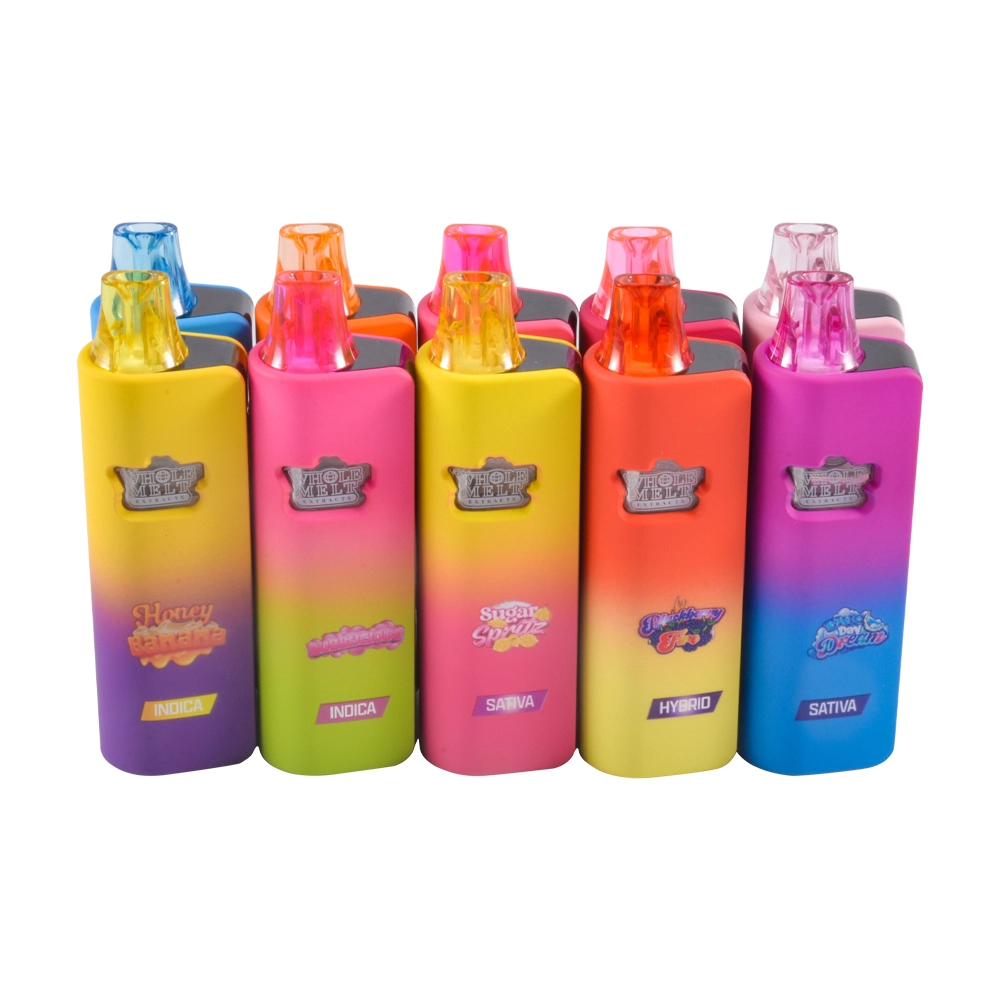
Whole Melt V7 Dual Chamber 2g Empty Disposable: 2025 Wholesale Buyer’s Guide
If you already work with the Whole Melt hardware lineup or want to add a dual-chamber 2g device to your catalog, the Whole Melt V7 dual chamber empty disposable is one of the most efficient ways to offer “two flavors in one device” without exploding your SKU count. This guide is written for B2B buyers who source whole melts disposable hardware in bulk and need clear specs, MOQ logic, OEM options, and QC checkpoints.
Important note: This article discusses empty hardware only (no oil, no THC, no nicotine). Always follow your local laws and testing rules for any formula you fill into the device.
1. What is Whole Melt V7 dual chamber empty disposable?
Whole Melt V7 dual chamber is a 2g empty disposable shell built around a 1g+1g dual tank layout. Instead of a single 2ml chamber, the body holds two isolated 1ml chambers, each with its own intake and ceramic heater. A selector or mode switch lets the end user choose Chamber A, Chamber B, or both, turning one device into a “two-in-one” flavor platform while your team still counts it as a single SKU.
On platforms like Vapetech420 and related B2B sites, Whole Melt V7 appears as a LED-screen 2g empty disposable designed for USA stock and bulk orders. The device is positioned as part of a complete Whole Melt family, alongside V3 and V5, so you can build a consistent series instead of one-off products.

2. Whole Melt series map: V3 / V5 / V7
To position Whole Melt V7 correctly on your price ladder and menu, it helps to see where it sits inside the broader Whole Melt series that many B2B buyers already know:
- Whole Melt V3 2g disposable: classic single-chamber 2ml empty shell, 310 mAh battery, Type-C charging, 4 × 1.6 mm oil intakes. Built for straightforward 2g lines where you only need one flavor per device.
- Whole Melt V5 2g disposable: 2ml empty shell with NFC verification options on some batches, still single chamber, designed as a “series upgrade” for brands that want more anti-counterfeit and branding features.
- Whole Melt V7 2g dual chamber: 1g+1g dual tank with LED screen, selector for dual flavors, and a more “tech-forward” look that fits premium lines and bundles.
In other words, V3 and V5 are your classic single-chamber workhorses, while V7 is your dual-chamber, LED-screen “hero” device that makes sense when you want to sell higher ticket SKUs or build curated two-flavor combos inside one shell.
3. Key specs and engineering details
Exact batch specs can vary slightly by factory and OEM project, but a typical Whole Melt V7 dual chamber 2g empty disposable for B2B buyers includes the following baseline parameters:
| Feature | Typical Whole Melt V7 Spec (Empty Shell) |
|---|---|
| Total capacity | 2g / ~2ml total, dual chamber 1g + 1g |
| Chamber layout | Two isolated tanks with independent intakes |
| Coil type | Ceramic heating cores matched to high-viscosity oils |
| Resistance | Approx. 1.0–1.6 Ω (check the latest spec sheet) |
| Intake design | Multi-hole intake (e.g. 4 × 1.5–1.6 mm) for thicker formulas |
| Battery | Rechargeable lithium-ion cell with USB-C charging |
| User interface | LED screen for battery / mode, side selector or button for flavor switching |
| Shell style | Whole Melt V7 industrial design with space for OEM logo and flavor icons |
| Packaging | Individual boxes + master cartons + stickers; OEM-ready layout |
Always request the current PDF spec sheet and, if possible, a tolerance map from your account manager so your lab and filling line can match viscosity, fill weight, and torque requirements correctly.
4. Why dual chamber 1g+1g helps B2B buyers
4.1 More flavor choice with fewer SKUs
Dual-chamber devices like Whole Melt V7 are designed to solve a simple retail problem: customers want more flavors, but every new SKU adds inventory complexity for your team. With 1g+1g dual chambers, one device can host:
- Two different strains or flavor profiles (e.g. “Day / Night” pairs)
- Two terpene styles (fruit-forward vs. gassy, dessert vs. classic)
- A “core flavor + seasonal collab” without launching a separate device
On the shelf, this means you can advertise pairings instead of single flavors while still counting a single product ID in your ERP. For multi-store operators and distributors, this cuts down on reordering complexity and reduces the risk of slow-moving single-flavor SKUs clogging the warehouse.
4.2 Better shelf impact and storytelling
Whole Melt V7 looks and feels more “high-tech” than a plain stick disposable. The LED screen and selector give your budtenders and sales reps something to explain in 10–15 seconds:
- “This one has two tanks inside — flip the selector for Flavor A, B, or both.”
- “It’s still a 2g device, but you get more variety out of a single unit.”
That short pitch is often enough to justify a higher price point where regulations allow, and it helps your Whole Melt corner stand out in a glass case full of generic sticks and bars.
4.3 SKU and logistics efficiency
For procurement, the math is simple: instead of buying two separate 2g single-flavor disposables, you can create a two-flavor concept by filling both chambers of the same V7 shell. Fewer SKUs mean:
- Simpler forecasting (you track pairs instead of dozens of individual flavors)
- Less shelf space per flavor pair
- Cleaner reporting on what pairs actually sell through
This is especially useful if you already bulk-buy other whole melts disposable hardware and want to keep the brand family tight while making your operations leaner.
5. MOQ, pricing tiers, and sample strategy
5.1 Typical MOQ ranges for Whole Melt V7 dual chamber
Exact numbers depend on the warehouse and customization level, but B2B buyers usually see:
- Standard USA stock: MOQs starting from a few hundred units per lot (for example, 200–500 pcs/lot for plain Whole Melt V7 shells with standard packaging).
- OEM / printed shells: Higher MOQs (often 1,000 + units) to unlock custom colors, logos, and fully branded boxes.
The safest approach is to start with one or two flavor pairs in standard stock shells, then step into OEM printing once you see real sell-through and know which pairs deserve a long-term position in your lineup.
5.2 Pricing tiers and landed-cost thinking
Wholesale pricing for Whole Melt V7 dual chamber empty disposables follows the usual pattern:
- Unit cost drops as quantity goes up.
- USA stock tends to be slightly higher per unit than direct factory orders, but faster and easier for smaller buyers.
- Printed OEM projects sit at the upper end of the range but support better retail pricing and stronger brand recall.
Instead of only comparing ex-factory prices, calculate your full landed cost by combining:
- Unit price at your expected volume tier
- Freight, duties, and insurance
- Expected DOA / defect rate and RMA costs
- Fill, testing, packaging labor, and overhead
The right supplier and hardware choice is the one that protects your margin per finished unit, not just your hardware unit cost.
5.3 Sample and pilot-batch strategy
For V7 dual chamber shells, plan at least one structured pilot batch before a full launch:
- Order 20–50 units as engineering samples and dry-run them through your filling, capping, and storage pipeline.
- Track leak rate, coil consistency, and any screen/selector issues over 1–2 weeks.
- Let a small group of trusted retailers or budtenders test the finished units and collect feedback on draw feel and UI.
- Use that data to adjust viscosity, fill weights, and ramp-up quantity for your first “real” production run.
6. OEM, private label, and packaging options
6.1 Shell colors, logo, and flavor icons
Whole Melt V7 offers enough surface area for a clean brand system:
- Device shell: body color and accent color around the screen or mouthpiece.
- Logo area: front or side panels for your brand name and logomark.
- Flavor indicators: small icons or color tabs at the base to show which flavor is in each chamber.
Ask your supplier for the print template files so your designer can place artwork without cutting across vents, windows, or compliance text zones.
6.2 Box, insert, and sticker layers
A typical Whole Melt V7 OEM packaging stack includes:
- Inner box: individual carton with product visuals, legal text, and QR code or batch info.
- Outer carton: branded or generic master box for transport and back-of-house storage.
- Stickers / labels: flavor, batch, and tracking stickers for rapid identification in the warehouse.
For larger runs, you can add tray inserts, specialty finishes (spot UV, foil, embossing), and “series” iconography to connect Whole Melt V3, V5, and V7 visually.
6.3 Anti-counterfeit layers
With popular hardware like Whole Melt, copies and look-alikes are common. To protect your brand, consider:
- Unique serial or batch QR codes linked to a verification page.
- Holographic seals or tamper-evident labels that break when opened.
- NFC tags or app-based verification on higher-end SKUs.
The goal is simple: make it easy for retailers and customers to see that they are holding a real device produced and tested under your standards, not a random third-party copy of a Whole Melt-style shell.
7. QC, RMA, and risk control for Whole Melt V7
7.1 QC gates to request from suppliers
For dual-chamber devices, you should expect your factory partner to run—and document—at least these QC gates:
- IQC (Incoming Quality Control): inspection of batteries, PCBs, and plastic shells before assembly.
- In-process checks: random checks for seal quality, fit, and basic function during assembly.
- OQC (Outgoing Quality Control): sampling finished devices for draw, screen function, and visual defects before packing.
Ask for a simple QC summary (AQL levels, sampling size, and defect categories) so you know what has been checked before hardware leaves the factory.
7.2 Typical defect types and responses
Common hardware issues for dual-chamber empties include:
- One chamber firing correctly, the other not.
- Selector not reliably switching between tanks.
- Screen not turning on, or display artifacts.
- Minor fitting issues between shell halves.
For each defect type, document the rate by batch and share photos or short videos with your account manager. This makes it much easier to agree on RMA terms and long-term corrective actions (CAPA) instead of arguing case by case.
7.3 RMA policy and data tracking
Before you place a large PO for Whole Melt V7 dual chamber empty disposables, agree on:
- What DOA / defect rate is considered normal (for example, a low single-digit percentage).
- How replacements or credits will be handled if a batch exceeds that threshold.
- How long after delivery you can still claim defects for a given batch.
The better your defect tracking, the easier it is to protect your margin and keep the relationship with the factory transparent.
8. Compliance, battery testing, and shipping
Even though Whole Melt V7 shells are sold empty, they still contain rechargeable lithium-ion cells. Most carriers and regulators expect the battery design to have passed UN 38.3 transport testing, and they will ask for a UN 38.3 test summary plus SDS/MSDS documentation from the manufacturer.
For cross-border shipments, make sure you have:
- UN 38.3 test summary for the cell or pack used inside the device.
- Battery SDS/MSDS in English (and local language if required).
- Correct labels and packaging for “lithium batteries in equipment.”
Once you start filling these devices with your own formulas, you will also need to map local rules for ingredients, emissions testing (where applicable), labeling, age-gate requirements, and product registrations. Treat hardware compliance and formula compliance as two separate but connected workstreams.
9. FAQ: Whole Melt V dual chamber empty disposable
9.1 Is Whole Melt V7 dual chamber 2g sold empty or pre-filled?
On B2B hardware platforms, Whole Melt V7 dual chamber is typically sold as empty hardware only. That means you receive shells with integrated batteries and electronics, but you fill them with your own compliant formulas and run your own testing before retail.
9.2 What is the difference between Whole Melt V5 and V7?
Whole Melt V5 is a single-chamber 2g/2ml empty disposable; Whole Melt V7 is a dual-chamber 1g+1g design with LED screen and selector. V5 is ideal for classic single-flavor lines, while V7 is designed for dual-flavor concepts and premium storytelling.
9.3 What kind of oils work with Whole Melt V7 dual chamber?
The hardware is designed around ceramic coils and multi-hole intakes that support modern high-viscosity oils. Exact compatibility depends on your formula and local laws, so always test your own blends in pilot runs and follow local regulations before going to market.
9.4 What MOQ should I plan for a branded Whole Melt V7 launch?
For plain stock shells, MOQs of a few hundred units per lot are common. For fully branded OEM projects (printed shells + custom boxes), you should be prepared for 1,000+ unit MOQs per design. Check the current Vapetech420 product page and confirm details with your account manager.
9.5 How do I start if I have never run a dual-chamber device before?
A simple path is: test 20–50 units as engineering samples, then run a 200–500 unit pilot with 1–2 flavor pairs. Track leak rate, customer feedback, and sell-through; once you see stable performance, you can step up to full OEM runs and expand your Whole Melt V7 flavor map.
Used correctly, Whole Melt V7 dual chamber 2g empty disposables can give your catalog a premium, two-in-one flagship that still fits inside your existing Whole Melt hardware family and logistics flow.
0 Comments