
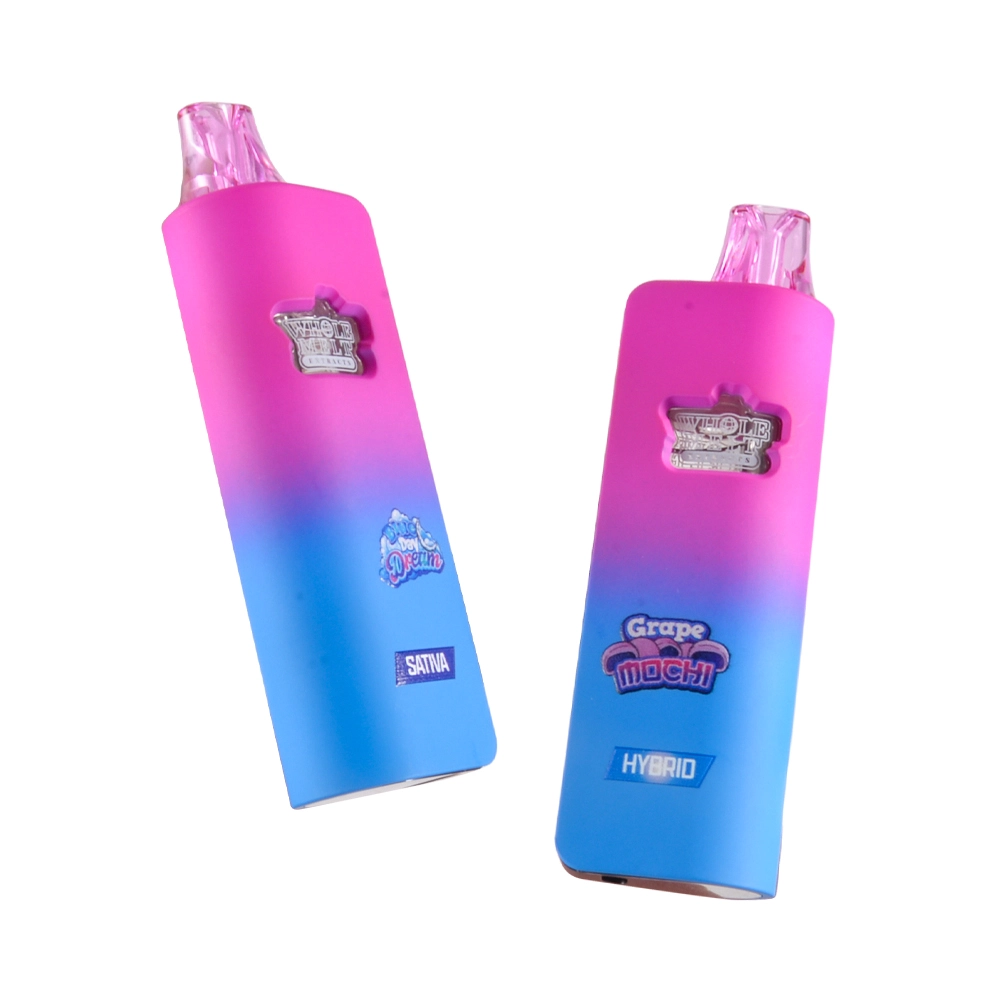
Whole Melt V7 2g Dual Chamber Empty Disposable for 2025 Bulk Orders
This article focuses on empty hardware only for age-21+ B2B buyers. It does not discuss THC/CBD content, health claims or consumption tips. Instead, it gives you a straight, hardware-first view of how the Whole Melt V7 2g dual chamber fits into your 2025 bulk program: specs, engineering, MOQ tiers, OEM options, QC and logistics.
Key Takeaways for 2025 Buyers
- True 2g dual chamber layout: Whole Melt V7 is built as a 1g + 1g dual chamber, all-in-one empty disposable</strong >, designed for thick oils and live extracts.
- Better SKU economics: a single device can cover two strains or flavor families, cutting shelf SKUs and warehouse lines while keeping choice high.
- LED feedback for 2025 users: LED indicator/screen improves user confidence on battery status and remaining capacity, reducing support tickets and returns.
- Wholesale-ready: V7 aligns well with 2025 demand for 2g, USB-C rechargeable, ceramic-coil hardware with robust compliance documentation and predictable lead times.
1. Whole Melt V7 Hardware Overview
1.1 Core Specs at a Glance
Whole Melt V7 is positioned as a dual-chamber, 2g total, all-in-one empty disposable platform. Exact numbers can vary slightly by batch or OEM configuration, but a typical spec map looks like this:
|
Parameter |
Typical Whole Melt V7 Spec (Empty Hardware) |
|---|---|
|
Total Capacity |
2g / 2ml (1g + 1g dual chamber) |
|
Chamber Layout |
Dual chamber, independent oil paths |
|
Coil Type |
Porous ceramic coil, optimized for high viscosity |
|
Resistance Range |
Approx. 1.2–1.4 Ω (thick-oil friendly range) |
|
Battery |
Rechargeable lithium-ion cell, USB-C charging |
|
LED Feature |
LED indicator / small LED screen for battery & usage feedback |
|
Activation |
Auto-draw, no button for end user |
|
Intake Design |
Enlarged inlets for live resin / rosin style oils |
|
Device Type |
Empty disposable hardware, to be filled and capped once |
The key is consistency: when you brief your supplier, make sure “2g” is clearly defined as 1g + 1g dual chamber, not a single 2ml tank, so your spec sheets, labels and QA checks all match.
1.2 How the Dual Chamber Works
In Whole Melt V7, each side of the device has its own oil path, coil and air channel. From a B2B point of view this gives you three options:
- Two strains, one device: e.g. “Day / Night” or “Indica / Sativa” positioning for your brand.
- Two flavor families: dessert vs fruit, classic vs limited edition, etc.
- Same strain, two formulas: e.g. standard vs “reserve” cut.
The end user only sees a simple interface: an LED indicator/screen and a switch selector. For you as a bulk buyer, what matters is that the two chambers are filled, capped and tested as if they were two separate 1g devices that happen to share a battery and chassis.
1.3 LED Indicator for Modern Users
2025 buyers expect feedback from their devices. A basic LED ring or compact LED screen can:
- Show battery state and charge progress.
- Signal faults (e.g. short-circuit or open coil) to reduce guesswork.
- Optionally display chamber selection or puff count.
You do not need a full smartphone-style screen to get these benefits. For most B2B programs, a simple, color-coded LED implementation is enough, as long as your spec sheet clearly defines what each signal means for QA and end-customer support teams.
2. Why Dual Chamber Matters for 2025 Bulk Buyers
2.1 SKU and Shelf Optimization
Dual-chamber hardware like Whole Melt V7 lets you reduce the number of separate SKUs you carry while keeping perceived variety high:
- Two strains per device → fewer labels, fewer boxes, fewer lines.
- Less shelf clutter in retail or distributors’ showrooms.
- Easier replenishment and forecasting because you track fewer, bigger SKUs.
2.2 User Experience and Retention
For adult consumers, dual-chamber hardware solves a simple problem: variety fatigue. Instead of carrying multiple devices, they can switch flavor families in-hand. That convenience tends to:
- Reduce the urge to “try a competitor” just for novelty.
- Support bundle pricing (“two-in-one” premium positioning).
- Make LED feedback more meaningful, because the device is used longer per unit.
From a B2B perspective this translates into stronger repeat-order stability when the engineering is done properly and failure rates stay low.
2.3 Example Use Cases
- Flagship collab SKUs: two partner brands share one device, each chamber carrying its own signature formula.
- Tourist or event lines: one side “introductory,” the other side “reserve,” packaged as a single limited drop.
- Retailers with small shelves: dual chamber lets you show more options without expanding case space.
3. Thick-Oil and Concentrate Compatibility
3.1 Coil and Resistance Window
Whole Melt V7 targets high-viscosity oils. The ceramic coil structure and 1.2–1.4 Ω range are chosen to:
- Heat slowly and evenly to avoid burnt notes.
- Maintain stable output even as the battery voltage drops over the session.
- Keep intake temperature within a tight, predictable band.
When you request samples, ask your supplier to share bench test data for coil resistance by batch, plus draw-curve plots at multiple fill levels. That data tells you more than any marketing line on a box.
3.2 Intake and Anti-Clog Features
High-viscosity oils demand wider and smarter inlets. On Whole Melt V7, key engineering points usually include:
- Multiple inlets per chamber with adequate diameter.
- Tight tolerance on post-fill sealing to avoid micro-leaks or back-pressure issues.
- Internal airflow paths that minimise sharp turns and dead corners where oil can condense.
Good vendors will also run stress tests under low-temperature storage and shipping conditions, since many clogs only show up after a few days in transit rather than in day-one lab tests.
3.3 Hardware-Side Best Practices
While every filling line has its own SOP, you can bake some best practices into your hardware spec:
- Define a clear maximum fill height per chamber line.
- Specify dwell time between filling and capping in your process documentation.
- Include a small sample of “cold storage + warm shelf” cycles in your QC test plan to simulate real transport and retail.
4. 2025 Market Context for 2g Dual-Chamber Hardware
4.1 Disposable Hardware Keeps Growing
Recent global reports show that the disposable vape hardware category has been growing at a healthy double-digit annual rate, and 2ml/2g segments are among the fastest-expanding tiers. For a B2B buyer, this signals two things:
- 2g formats are no longer “experimental”; they are mainstream.
- Competition will intensify, so engineering quality and compliance documentation matter more than ever.
4.2 Why 2g with LED and Dual Chamber Wins Shelf Space
On crowded shelves, 2g, dual-chamber, LED-equipped hardware gives you:
- Higher perceived value per device.
- More talking points for staff and budtender training.
- A clear visual difference from generic 1g disposables.
4.3 Implications for Your 2025 Lineup
In 2025, many wholesale programs mix three layers of hardware:
- Baseline 1g disposables for entry-level price points.
- 2g single-chamber devices as the “workhorse” line for frequent adult users.
- Whole Melt V7-style dual-chamber hardware as the premium or “hero” line with stronger storytelling and margins.
5. Wholesale Pricing, MOQ and Sample Strategy
5.1 Typical MOQ Tiers
Exact numbers depend on each factory, but most Whole Melt V7 programs follow a tiered MOQ structure, such as:
|
Tier |
Quantity Range |
Typical Use Case |
|---|---|---|
|
Samples |
10–50 units |
Bench tests, filling trials, internal team review |
|
Pilot Batch |
200–500 units |
Soft launch with limited retailers / regions |
|
Bulk Order |
1,000+ units |
Full-scale rollout, standard artwork |
|
High-Volume Program |
5,000+ units per PO |
National or multi-state distribution, OEM prints |
5.2 Sample and Pilot Strategy
- Start with multi-chamber samples: Ask for both “standard” and “premium” coil versions if available, and test with your thickest formulas.
- Run a small pilot batch: 200–500 units across a few key partners. Track failure rate, returns, and customer comments by chamber and batch ID.
- Lock spec before scaling: only after pilot data stabilises should you freeze your coil, battery and LED config for full-scale orders.
5.3 Thinking in Cost per Gram, Not per Device
For dual-chamber hardware it is often more useful to calculate cost per gram of filled oil rather than per device. Even if the V7 shell costs more than a 1g single-chamber unit, your per-gram hardware cost can still be attractive because one chassis carries two chambers and one battery.
6. OEM, Branding and Anti-Counterfeit Options
6.1 Shell and Color Strategy
Whole Melt V7 gives you enough surface to make your brand stand out without going over the top:
- Matte or soft-touch shells to match premium pricing.
- Dual-tone color splits aligned with each chamber’s flavor family.
- LED color mapping linked to strain type or line (e.g. blue vs purple).
6.2 Packaging Levels
For most 2025 programs you will see three main packaging configurations:
|
Level |
What It Includes |
|---|---|
|
Core |
Plain or lightly branded unit box, master cartons |
|
Branded |
Full artwork, flavor callouts, batch coding |
|
Premium |
Specialty finishes (spot UV, metallic), tamper seals, QR verification, inserts |
6.3 Anti-Counterfeit and Traceability
Because Whole Melt is a recognizable name, you should treat anti-counterfeit as a mandatory part of the V7 program:
- Unique QR or alphanumeric codes per unit or per batch.
- Scratch-off labels tied to a verification portal.
- Serialized master cartons for recall and traceability.
7. QC, Documentation and Factory Partnership
7.1 IQC, IPQC and OQC Basics
For a dual-chamber device like Whole Melt V7, you should expect your supplier to run layered quality checks:
- IQC: incoming inspection of cells, shells, coils.
- IPQC: in-process checks during assembly and post-fill, including basic draw tests on each production line.
- OQC: outgoing checks on finished devices and random stress tests on sample units.
7.2 What to Ask For in Test Reports
At minimum, your factory partner should be willing to share:
- Draw-resistance ranges before and after aging tests.
- Visual inspection criteria for leakage around mouthpiece and seams.
- Battery performance under multiple partial-charge cycles.
- Failure classifications (e.g. no-fire, short, clog, cosmetic).
7.3 CAPA and RMA Expectations
No hardware program is failure-free. What matters is your supplier’s corrective and preventive action (CAPA) discipline:
- Clear, written RMA process and response timelines.
- Factory-side root-cause analysis for each significant issue category.
- Documented corrective actions on the line (fixture changes, inspection frequency, etc.).
8. Compliance and Shipping for Whole Melt V7 Programs
8.1 Battery and Safety Standards
Because V7 is a rechargeable all-in-one device with a built-in lithium-ion cell, you should confirm that:
- The cell and pack have passed relevant transport tests (commonly referenced as UN 38.3).
- The manufacturer can provide safety test reports in line with lithium-battery standards such as IEC 62133-2 or equivalent.
- Material Safety Data Sheets (MSDS) for the cell are available for freight forwarders and customs.
8.2 Paperwork and “Hardware-Only” Positioning
To keep your risk controlled:
- Make sure contracts, invoices and product descriptions clearly mark V7 as empty hardware.
- Align your age-gating and customer onboarding with applicable regulations in your destination markets.
- Work with carriers and brokers who already understand vape hardware and lithium-battery transport requirements.
8.3 Lead Times and Incoterms
Typical lead-time ranges for Whole Melt V7 programs look like:
|
Order Type |
Lead Time (Production) |
Notes |
|---|---|---|
|
Sample |
3–7 days |
Standard shell, no custom print |
|
Pilot |
7–14 days |
Limited artwork, test quantities |
|
Bulk |
14–25 days |
Custom branding, full QC documentation |
Combine this with your preferred Incoterms (EXW, FOB, DAP, DDP) and build a simple reorder calendar so your V7 line never runs dry during peak seasons.
9. How to Brief Your Supplier for a Whole Melt V7 Program
9.1 Data to Prepare on Your Side
- Your thickest oil’s viscosity range and typical fill temperature.
- Target markets and shipping lanes (domestic vs cross-border).
- Brand positioning (value / mid / premium).
- Planned volumes by quarter.
9.2 Key Questions to Ask
- What dual-chamber tolerance map do you use for V7?
- Can you share recent V7-specific test reports and failure stats?
- Which LED indicator options are proven in production?
- How do you handle RMA and CAPA for dual-chamber lines?
9.3 Red Flags to Avoid
- No written test plan for dual-chamber models.
- Unclear or missing battery documentation.
- Inconsistent answers on capacity (2ml vs 2×9ml, etc.).
- Unwillingness to run a pilot batch before large POs.
In 2025, Whole Melt V7 2g dual chamber empty disposables give B2B buyers a way to combine premium user experience with better SKU economics. If you lock your spec correctly, verify your factory’s documentation, and build a sensible sample–pilot–bulk roadmap, V7 can sit alongside your other Whole Melt lines as a stable, repeatable pillar in your hardware portfolio.
FAQ: Whole Melt V7 2g Dual Chamber Empty Disposable
Is Whole Melt V7 pre-filled?
No. This guide and the underlying hardware are for empty disposable devices only. Filling, formulation and compliance for contents sit with your own licensed operations.
What makes Whole Melt V7 different from regular 2g disposables?
V7 offers a 1g + 1g dual-chamber layout, LED feedback and a thick-oil-oriented ceramic coil system, letting you carry two strains or profiles in one chassis instead of two separate devices.
Is dual-chamber hardware harder to manage for QC?
It requires a clearer test plan—each chamber should be validated like an individual 1g device—but once your supplier documents IQC/IPQC/OQC properly, the day-to-day QC flow is manageable.
What is a reasonable starting MOQ for V7?
Many programs start with 10–50 sample units, then a 200–500 unit pilot batch before moving to 1,000+ unit bulk orders once performance and feedback are stable.
Does this article provide legal or health advice?
No. This page is for hardware-only, B2B information about empty devices, aimed at age-21+ wholesale buyers and brands. You should consult qualified legal and compliance professionals for regulatory questions in your own markets.
If you want more vape for sale, you can go through those pages: cbd disposable vape|2 gram disposable vape pen| Whole Melt|whole melts disposable
0 Comments