
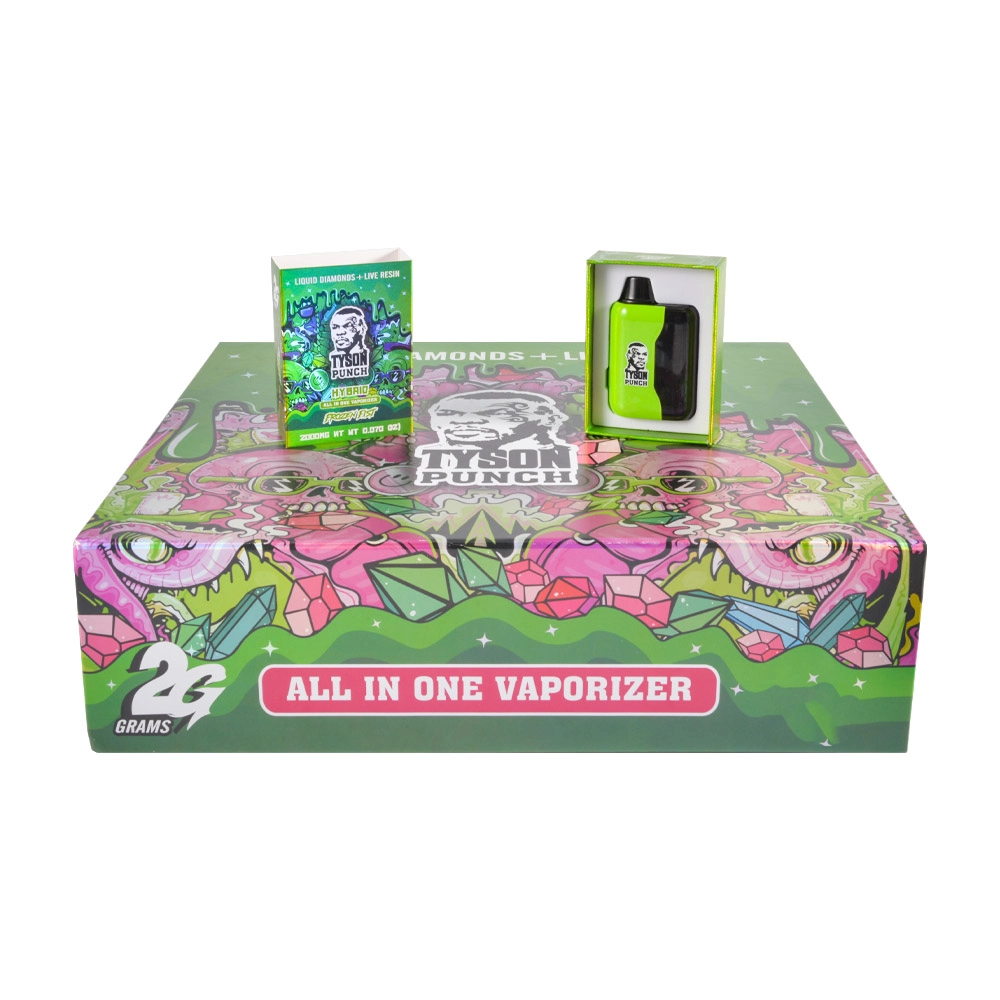
Tyson Punch empty disposable shell specs for B2B buyers
(hardware-only, not affiliated; engineering and compliance guide)
Who this is for. This article is written for B2B buyers and process engineers who are sourcing empty “Tyson Punch-style” disposable shells and need hard technical guardrails—coil construction, inlet sizing, viscosity handling, QA, and shipping compliance. All recommendations below reference primary, industry-recognized sources and avoid promotional claims.
1) Quick spec snapshot (what most buyers ask first)
-
Atomizer: porous ceramic core is the de-facto standard for high-viscosity cannabis oils because it wicks through micro-pores and distributes heat uniformly; major cartridge OEMs (e.g., CCELL) design their 510 and AIO platforms around ceramic heating cores.
-
Inlet (oil aperture) options: industry-standard diameters offered by CCELL are 1.2 / 1.4 / 1.6 / 1.8 / 2.0 mm; customization is typically possible. As viscosity rises, aperture size (and/or count) should increase. For thick oils, most buyers evaluate 1.6–2.0 mm first.
-
Viscosity reality: live resin/rosin can be far thicker than “a few thousand cP” at room temperature; reputable labs measure viscosity while controlling temperature and often work the oil warm to achieve a usable (working) viscosity rather than quoting a single room-temp number.
-
Working temperature window (handling/filling): many production teams target roughly 45–65 °C (113–149 °F) from bulk tank to needle to stabilize flow, cut bubbles, and improve fill repeatability.
-
Battery/charging: USB-C is now common on modern AIOs; confirm on a per-model basis and verify that charging and power management are covered by UL/IEC testing (see §6).
2) Coil type: why porous ceramic remains the default
Porous ceramic atomizers present thousands of micro-inlets that absorb viscous oil and deliver it across the heater surface more uniformly than cotton wicks. That combination—capillarity plus even heat distribution—reduces dry-hit risk and helps preserve volatile terpenes. The prevalence of ceramic in leading OEM platforms is itself a market signal for thick-oil compatibility; when in doubt, prioritize ceramic over cotton for solventless and other higher-cP feeds.
What to specify to vendors
-
Ceramic grade and porosity class (if available)
-
Nominal resistance (Ω) tolerance
-
Whether the design includes multi-path feed or pre-heat functions
3) Inlet sizing (aperture diameter & count): getting feed vs. leak right
Aperture diameter governs feed rate into the core. CCELL publicly lists five standard sizes—1.2 / 1.4 / 1.6 / 1.8 / 2.0 mm—and notes that sizing can be customized to the oil’s characteristics. For “Tyson Punch-style” 2 g AIO shells targeting thicker oils, start at 1.6 mm, step to 1.8 mm if you see starvation at use temperature, and go 2.0 mm only if leak controls (seal geometry, cap torque, soak time) are robust. Multi-inlet patterns (e.g., 4×) can increase total inflow without pushing a single aperture too large.
Fast decision grid
-
Stable wicking at your use temp → keep ~1.6 mm.
-
Intermittent dry hits at the same drive profile → test 1.8 mm.
-
Persistent starvation in colder climates or during rapid draws → evaluate 2.0 mm with extended soak-and-leak tests.
4) Viscosity: measure it, don’t guess it
Room-temperature viscosity for cannabis extracts varies wildly by composition and shear, so credible labs use viscometers (e.g., RheoSense microVISC/VROC) and log cP versus temperature to select the lowest handling temperature that still delivers reliable filling and capillary feed. Expect test sweeps over 40–70 °C in development; do not force one “magic cP” at ambient for all formulas.
Action items for your batch records
-
Calibrated viscosity runs (instrument, chip, temperature points, shear)
-
A short cP–T curve showing the chosen working window
-
Notes on changes in terpene content or diluent that affect viscosity
5) Filling & process controls (reduce rejects before they start)
Manufacturing teams that work within ~45–65 °C from bulk tank through heated lines and needle report fewer bubbles, more consistent fills, and reduced manual rework. Keep residence time as short as possible to protect volatiles; aim for precise temperature control rather than “hotter is better.” If your oil is at the low-viscosity end (heavily cut distillate), validate that your chosen aperture set doesn’t over-feed after warm-soak.
QA checklist per lot
-
Verify inlet diameter(s) and count with metrology before line trials.
-
Confirm coil resistance within spec; re-measure after capping (some assemblies shift).
-
Leak tests: vacuum/positive-pressure, 24-hour upright rest, and cold-soak cycles for climate exposure.
-
Document fill weight vs. target and needle/tank temperatures; retain samples and records.
6) Safety & shipping: what your compliance packet should contain
Even for empty shells, buyers increasingly ask for documentation covering electrical and battery safety as well as air transport:
-
UL 8139 — evaluates the safety of the electrical, heating, battery, and charging systems in e-cigarettes and vape devices; recognized by ANSI and SCC. Ask vendors for a current test report or certification letter referencing the exact model.
-
IEC 62133-2:2017 — international requirements and tests for portable lithium-ion cells and batteries; relevant when your AIO has an embedded rechargeable pack. Obtain CB/IECEE or equivalent reports as applicable.
-
UN 38.3 / IATA DGR 66th (2025) — to travel by air, lithium cells/batteries must pass UN 38.3; shippers must maintain a Test Summary and follow current labeling/SoC rules in the IATA Lithium Battery Guidance Document 2025.
Buyer note. Match the document model numbers to the physical SKU and revision (PCBA changes, cell vendor changes, or port changes mean new evidence).
7) What a clean, non-promotional spec looks like (template you can send to suppliers)
-
Form factor / nominal fill volume: e.g., 2.0 mL (marketed as “2 g” casing)
-
Atomizer: porous ceramic; nominal resistance ± tolerance (e.g., 1.4 Ω ± 0.1 Ω)
-
Inlets: pattern and diameter (e.g., 4×1.6 mm; alternative builds at 1.8/2.0 mm on request)
-
Materials: tank (PCTG/PC), seals (silicone grade), mouthpiece style
-
Electronics: battery capacity (mAh), charge port (USB-C), protections (OVP/OCP/OTP)
-
Accessories: caps, tamper seals, QR/serialization options
-
Compliance: UL 8139, IEC 62133-2, UN 38.3 Test Summary (if rechargeable), RoHS documentation where required
8) Buyer checklist (print this before you issue a PO)
-
Non-affiliation clarity on your listing and packaging (hardware-only).
-
Dimensional proof of inlets (certificate or sample inspection report).
-
Viscosity & temperature plan for your oil, with cP–T curve in batch docs.
-
Line trials at your coldest expected ambient (simulate winter shipping/retail).
-
Compliance packet: UL 8139/IEC 62133-2 evidence and UN 38.3 Test Summary for the embedded cell/battery; verify model numbers and dates.
-
Traceability: lot-level labels, QR codes, and retention samples for at least one year.
FAQs
What inlet size should I choose if I don’t have lab data yet?
Start with 1.6 mm on a multi-inlet design and validate at your handling temperature; step to 1.8 mm or 2.0 mm only if you observe starvation under realistic draws and climates.
Is there a universal viscosity number for “thick oils”?
No. Viscosity is highly temperature-dependent; obtain measured cP vs. temperature and target the lowest temperature that gives stable flow in your device.
What’s a reasonable handling temperature?
A practical band many operators use is ~45–65 °C, which balances flow with terpene preservation and reduces bubbles and rework. Always confirm on your own oil.
Which certificates do freight forwarders actually check?
For rechargeable AIOs: a current UN 38.3 Test Summary and alignment with the IATA Lithium Battery Guidance Document (2025), often alongside UL/IEC safety evidence in customer audits.
Bottom line. If you want a Tyson Punch-style empty disposable shell that works with thick oils and passes buyer diligence, specify porous ceramic, start your inlet band at 1.6–2.0 mm, run viscosity as cP vs. temperature, and insist on UL 8139 / IEC 62133-2 / UN 38.3 documents that match the exact model you buy. These steps will do more for performance and compliance than any marketing language ever could.
If you want more Vape in bulk, you can go through those pages: empty disposable vape|2 gram disposable vape pen|wholesale tyson|tyson disposable wholesale
0 Comments