
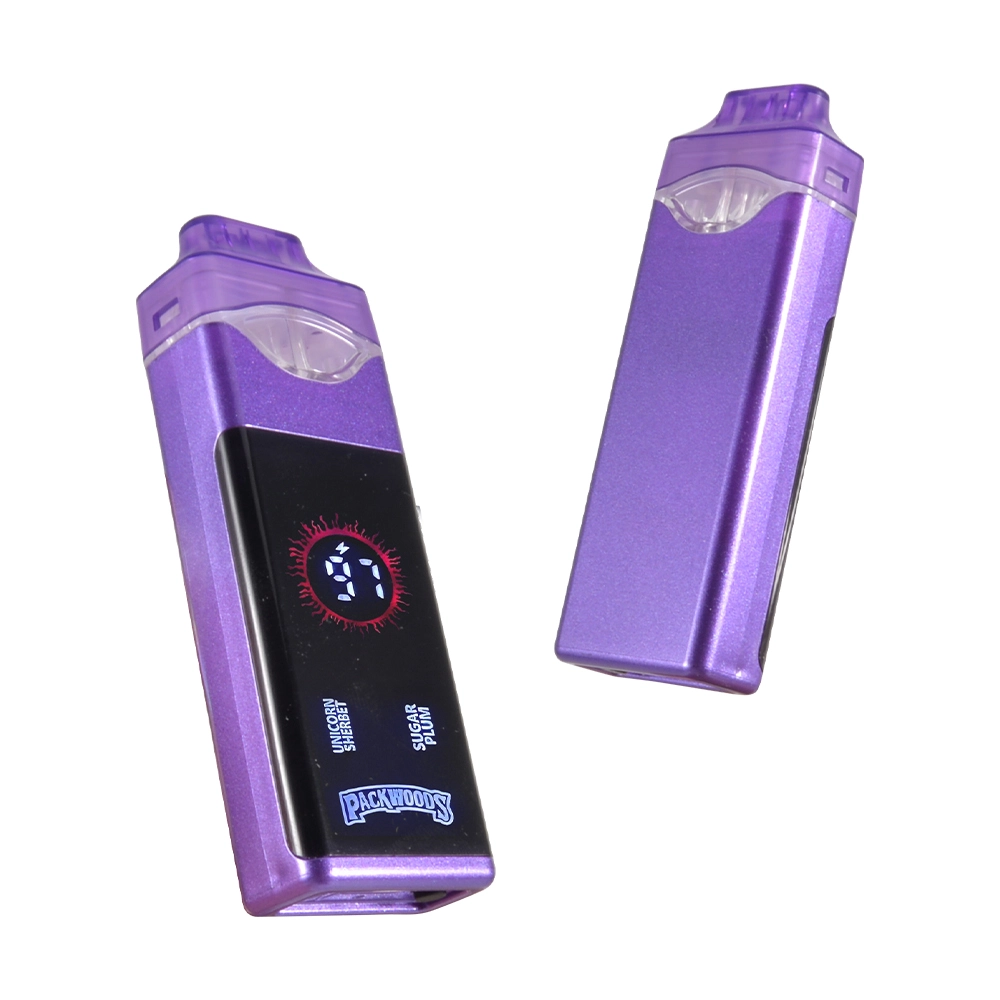
Packwoods Dual-Chamber 1g+1g with Full LED Screen (Empty) — A 2025 Buyer’s Guide
Empty hardware only. No THC/Nicotine. Nominative use only—no affiliation implied.
“Packwoods dual-chamber 1g+1g with full LED screen” is a popular format descriptor buyers search when they want a modern 2-gram-class chassis: two separate 1 g reservoirs in one device, a flavor/strain switch, USB-C charging, and a full-face LED display for battery/puff/alerts. On VapeTech420.com, this is positioned strictly as empty hardware for licensed fillers. This guide explains what to look for at the top of the funnel so you can shortlist serious OEM options and avoid compliance surprises.
1) What the dual-chamber 1g+1g + full LED format actually means
-
Two 1 g chambers (total 2 g capacity class): each side is typically isolated with its own intake ports so the user can toggle flavors/strains without mixing.
-
Full LED screen: shows battery, charge state, and often puff/alert icons; gives a premium feel and reduces “mystery battery” complaints.
-
Ceramic heating core: today’s default for thick oils; seek even heating and multi-port wicking.
-
Rechargeable USB-C: helps the device finish the full 2 g load—important for customer satisfaction and returns.
⚠️ Specs vary by factory. Treat online photos as industrial design cues, not proof of materials, firmware, or safety systems. Ask for documentation (Section 4–5).
2) Why brands consider dual-chamber
-
Trial without extra SKUs: run A/B flavors or a “day/night” concept under one barcode.
-
Shelf pop: the LED face and two-flavor story build perceived value at the budtender counter.
-
Fewer dead-on-arrival complaints: rechargeability + battery gauge reduces “battery died before empty” support tickets.
These are good TOFU talking points—but they only matter if the device is engineered to pass today’s safety expectations.
3) Metals safety: design for the “Big Four” (and friends)
Most U.S. cannabis programs include heavy-metal screening in product safety testing. Panels commonly focus on lead (Pb), cadmium (Cd), arsenic (As), and mercury (Hg) because of well-documented neurotoxicity and organ risk; some jurisdictions or labs also track nickel/chromium/copper/antimony due to coil and alloy concerns. As research has expanded, studies in 2024 detected nano-sized toxic metal particles in cannabis vapes—even before first use—with worse findings in unregulated hardware. That’s why buyers should validate materials and component design, not just branding.
What to request from suppliers (metals):
-
Hardware COA or component screening from an ISO/IEC 17025 lab (ICP-MS or equivalent) for wetted parts (center post, coil housing, solder points, reservoir path), explicitly reporting Pb/Cd/As/Hg; ask whether Ni/Cr/Cu/Sb are included.
-
A note on alloys/ceramics used (e.g., lead-reduced/brass alternatives, stainless grades, ceramic formulation).
-
Batch/lot traceability so you can tie documentation to the exact devices you receive.
4) Battery & transport compliance: documents that separate serious hardware from clones
Because this device class is rechargeable lithium, it falls under well-defined global frameworks:
-
UN 38.3 — required design tests for lithium cells/batteries in transport. Since recent rulemakings and industry guidance, a UN 38.3 Test Summary (TS) must be available through the supply chain; shippers and buyers should be able to review it.
-
IEC 62133-2 — international safety requirements for portable lithium cells and batteries used in consumer equipment; widely referenced for design conformity.
-
UL 8139 (2nd ed., 2024) — evaluates electrical, heating, battery, and charging systems of e-cig/vape devices; ANSI/SCC-recognized and commonly used in North America to demonstrate a robust electrical safety design.
What to request from suppliers (battery/electrical):
-
The UN 38.3 Test Summary for the exact cell or pack model used in the device (check model numbers).
-
A test report or certification to IEC 62133-2 (or a reputable lab’s evaluation against it).
-
Evidence of evaluation to UL 8139 (2nd ed., 2024), or at minimum a third-party report that the design aligns with its hazard controls (over-charge, short-circuit, thermal protections, charging circuitry).
5) LED-screen devices: extra QA questions to ask
A full-face LED looks great, but it adds firmware and power-management complexity. Ask:
-
Does the screen draw interfere with heating stability at low state-of-charge?
-
Charge safety: is input current limited; is there temperature or time-out protection during USB-C charging? (UL 8139-style controls).
-
Accuracy of indicators: does “battery 0 %” appear before the load is fully vaporized, or is there headroom?
-
Ingress & bonding: is the window sealed to prevent condensate from reaching the PCB?
-
EMC/ESD: any testing to show the display logic won’t misfire during electrostatic events?
6) Sourcing checklist for Packwoods-style dual-chamber 1g+1g (empty)
Use this buyer template when you engage vendors on VapeTech420:
-
Metals & materials
-
ISO/IEC 17025 COA showing Pb/Cd/As/Hg below strict inhalable thresholds; note any Ni/Cr/Cu/Sb screening.
-
Written disclosure of alloys/ceramics/gaskets in the vapor path.
-
-
Battery & electrical
-
UN 38.3 Test Summary (model-matched).
-
IEC 62133-2 conformity evidence for the cell/pack.
-
UL 8139 evaluation/report for the device’s electrical system.
-
-
Design details
-
Separate air paths for each 1 g chamber; leak-resistant chimney; multi-port ceramic for viscous oils.
-
USB-C input current spec; protection features; labeled polarity/charging guidance.
-
-
Traceability & packaging
-
Lot numbers on device cartons; tamper-evident packaging; serialization/QR that points to the brand’s own verification domain (avoid look-alike links).
-
-
Pilot & validation
-
Run pilot fills with your thickest oils; measure leak/return rates and any metals drift over storage intervals (a best-practice noted in recent reviews).
-
7) Quick RFP spec block (copy/paste)
-
Form factor: dual-chamber 1 g + 1 g, independent intakes; switchable.
-
Heating: ceramic core, even-heat design, multi-port wicking.
-
Battery: rechargeable lithium, USB-C; provide UN 38.3 TS and IEC 62133-2 evidence.
-
Electrical safety: UL 8139 evaluation or third-party report aligned to 2nd ed. (2024).
-
Display: full LED screen (battery/puff/alerts); confirm power budgeting and protections.
-
Materials: disclose all wetted metals/ceramics/gaskets; provide metals panel COA including Pb/Cd/As/Hg (plus Ni/Cr recommended).
-
Traceability: lot/serial/QR with verifiable domain controls.
-
Packaging: tamper-evident seals; ship-ready labeling compliant with lithium battery transport rules.
8) Bottom line
A Packwoods-style dual-chamber 1g+1g with full LED screen can be a compelling 2-gram-class platform for branding and user experience. But in 2025, the winners are the devices that prove their design: metals-safe component choices and battery/electrical compliance backed by documents you can show to partners, insurers, and regulators. Build your shortlist around UN 38.3 + IEC 62133-2 + UL 8139 and a real metals COA—then let the LED-screen polish help you close the sale.
If you want more Vape in bulk, you can go through those pages: empty disposable vape|2 gram disposable vape pen|vape in USA
0 Comments