
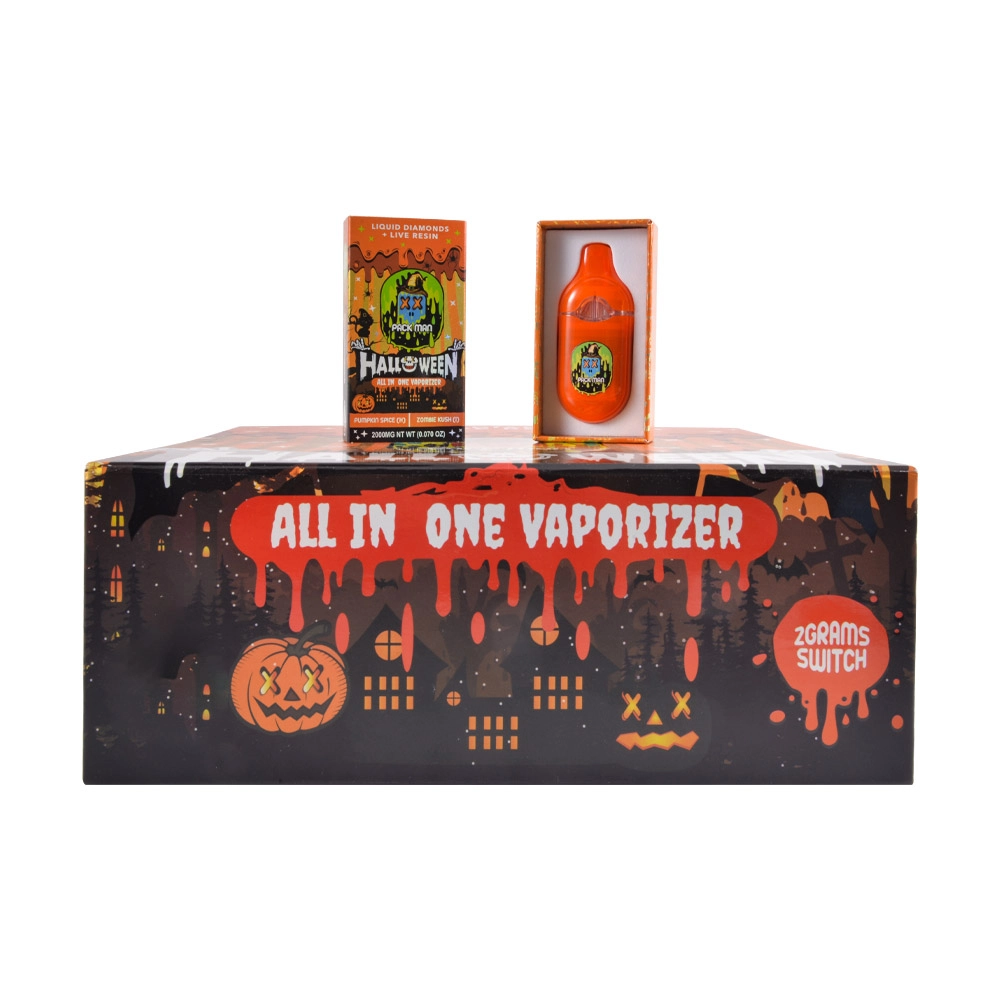
1. What “Packman 2g empty disposable vape” actually refers to
In the B2B/OEM market, “Packman 2g” has become a shorthand for a 2.0 mL / 2 g-capable, box-style disposable designed for thicker extracts, sold as empty hardware for compliant licensees to fill.
Across multiple reputable wholesalers and OEM listings, you’ll see a broadly consistent spec pattern:
-
Tank capacity: 2.0 mL (marketed as “2 g” compatible)
-
Battery: typically 320–400 mAh, rechargeable
-
Charging: USB-C charging port
-
Heating core: upgraded / full ceramic coil
-
Resistance: about 1.4 Ω
-
Oil intakes: often 4 × ~1.6 mm apertures (multi-intake for thick oils)
-
Features: draw-activated and/or preheat function; customizable shell and packaging options
Different factories publish slightly different numbers, but this cluster is your realistic baseline. Always lock specs in writing for your exact SKU.
Important: “Packman” is a mark used in the market; unless you are directly authorized, position your offer as “Packman-style 2g empty disposable hardware” and make the hardware-only / not-affiliated status clear on VapeTech420.
2. Why 2g + ceramic + multi-intake is the current sweet spot
For B2B buyers working with live resin, liquid diamonds, distillate blends, or solventless rosin, the Packman 2g-style shell solves three practical problems:
-
Headroom for modern formulations
2.0 mL is now a standard request for high-value formulations. It reduces packaging overhead per mg and allows multi-day use without constant device churn. -
Porous ceramic coil (~1.4 Ω)
Porous ceramic has become the industry default for higher-viscosity oils because it:-
wicks through micro-pores instead of relying on cotton,
-
spreads heat across a larger surface area, and
-
helps reduce scorching and terpene loss.
Leading hardware brands (e.g., CCELL) predicate their platforms on ceramic cores for these reasons.
-
-
Multi-intake design (e.g., 4 × 1.6 mm)
CCELL’s own guidance confirms that thicker oils need larger or multiple inlets and that they offer 1.2 / 1.4 / 1.6 / 1.8 / 2.0 mm as standard options.
Packman-style 2g empties that use a 4 × ~1.6 mm pattern follow that logic: more total intake area to support viscous oils while retaining control against flooding.
For VapeTech420’s B2B audience, that combo—2.0 mL + ~1.4 Ω ceramic + multi-intakes + USB-C—isn’t just marketing language; it’s an engineering response to how modern oils actually behave.
3. Matching thick oils: viscosity, temperature, and why this design works
Here’s where serious buyers separate themselves from “we just like the box” shoppers.
Cannabis oils are extremely viscosity-sensitive. RheoSense application notes and SOPs show cannabis oils and concentrates spanning roughly 4,000 up to 800,000+ cP, with viscosity dropping sharply as temperature increases from ~40–70 °C.
What that means for a Packman 2g empty:
-
At room temperature, many live resin/rosin blends are far thicker than generic “e-liquid” assumptions.
-
Multi-intake (e.g., 4 × 1.6 mm) plus a porous ceramic core is fundamentally more forgiving for those high-cP oils than a small, single-aperture layout.
-
You should be designing around a “working viscosity window”, not a single room-temp number:
-
Run cP vs. temperature tests.
-
Choose the lowest handling temperature that:
-
allows stable filling (no voids, no over-pressure),
-
feeds consistently through those 4 × 1.6 mm intakes at your target voltage.
-
-
If your oil is thinner (more diluent, high terp fraction), you must verify that the same multi-intake design does not flood at storage and use temps. The hardware gives you room; your formulation and QA decide whether it behaves.
4. Core specs a Packman 2g empty should document (and you should demand)
For a credible listing on VapeTech420, every Packman 2g-style empty disposable should publish at least:
-
Tank capacity: 2.0 mL
-
Battery: stated capacity (e.g., 320–400 mAh), chemistry (Li-ion), and rechargeability
-
Charge port: USB-C
-
Coil: porous ceramic, nominal resistance (e.g., 1.4 Ω ± tolerance)
-
Oil intake: exact pattern & diameter (e.g., 4 × 1.6 mm)
-
Activation: draw-activated and/or button + preheat profile
-
Materials: body + tank (e.g., PCTG/PC), seals (silicone grade), heavy-metal-safe wetted path if claimed
-
Customization: logo, color, packaging options for white-label
-
Intended use: clearly “empty hardware only; to be filled by licensed operators”
These numbers are consistent with multiple Packman 2g-style OEM spec sheets currently on the market, but you should always verify against the manufacturer’s official datasheet for your batch.
5. Safety and shipping: the non-negotiables for rechargeable 2g devices
Empty or not, once there’s a rechargeable lithium battery inside, big buyers and carriers will expect the standard documentation set. For Packman 2g-style empties, insist on:
-
UL 8139 testing (or equivalent)
UL 8139 is recognized in the U.S. and Canada as the safety standard for the electrical system of electronic cigarettes and vaping devices—covering battery, charging, protection circuits, and heating elements. -
IEC 62133-2 evidence for the Li-ion cell/pack
This is the globally referenced safety standard for portable secondary lithium cells and batteries. -
UN 38.3 compliance + Test Summary (TS)
Any lithium battery shipped by air must pass UN 38.3, as detailed in the UN Manual of Tests and Criteria and reinforced by the IATA Lithium Battery Guidance Document 2025 and PHMSA/other regulators. TS can be provided as a PDF or hosted via QR/URL.
For VapeTech420’s positioning, this is key: a Packman 2g empty shell that looks great but has no UL/UN/IEC paperwork attached to the actual battery and model number is not “premium hardware”—it’s a liability.
6. Practical QC & sourcing checklist for Packman 2g empties
If you’re evaluating a Packman 2g empty disposable line, treat this as your minimum due diligence:
-
Spec match
-
Confirm 2.0 mL, ceramic coil, resistance, USB-C, and intake dimensions in a signed datasheet.
-
Check that what arrives physically matches that sheet (calipers + ohm meter).
-
-
Functional tests
-
Run fill trials with your intended oils:
-
Filling at a controlled temperature (often in the 45–65 °C range, based on viscosity data and industry practice) with recorded parameters.
-
24–72 h upright + horizontal rests; cold-soak tests to screen for leaks or starvation.
-
-
-
Document review
-
Obtain UL 8139 statement/test report reference for the specific device.
-
IEC 62133-2 documentation for the embedded cell (if rechargeable).
-
UN 38.3 TS with matching cell & device identifiers.
-
-
Brand & IP hygiene
-
If the device carries Packman-style branding, confirm you’re not infringing trademarks or misrepresenting affiliation.
-
Clearly describe offers on VapeTech420 as empty hardware for licensed fillers, not as pre-filled THC/HHCP/etc products.
-
-
Ongoing monitoring
-
Track leak rate, DOA rate, and any field feedback per batch.
-
Re-qualify if the factory changes battery vendor, PCB, coil design, or shell tooling.
-
7. Why Packman 2g empties belong in a professional catalog (and when they don’t)
When the above boxes are ticked, a Packman 2g-style empty disposable vape offers:
-
a familiar, in-demand form factor,
-
engineering tuned for higher-viscosity oils,
-
rechargeable convenience to reduce half-used returns, and
-
a large printable/brandable surface for compliant labeling.
When those boxes are not ticked—no verifiable specs, no safety reports, vague origin—it’s just a risky clone with a trendy silhouette.
If you want to know more packman wholesale,pls go through these pages:packman disposable wholesale|packman 2g bulk|packman 2g disposable wholesale
0 Comments