
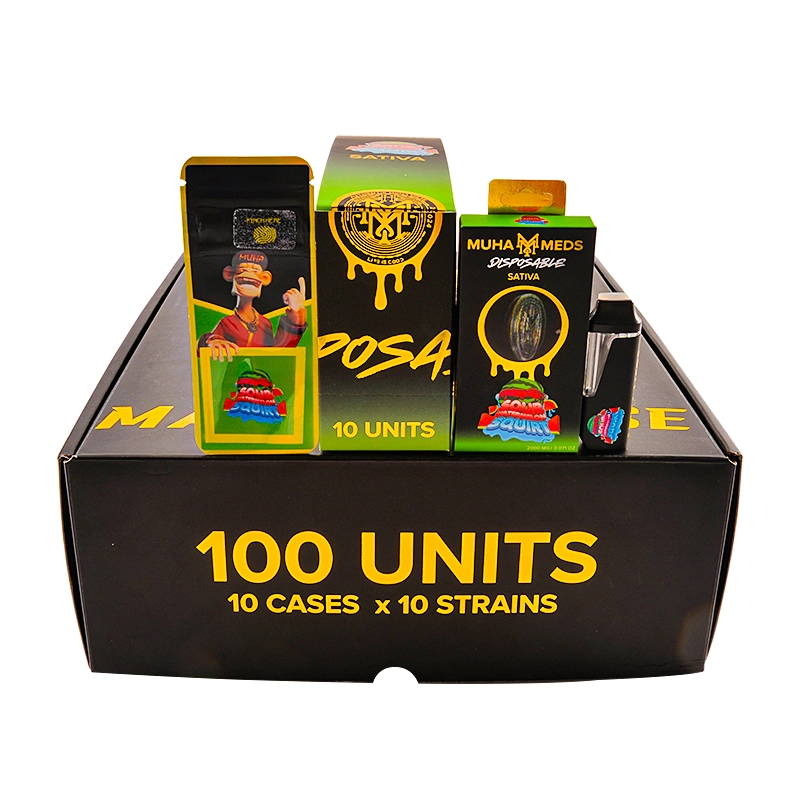
Summary (for first-time readers): An “empty disposable” is the finished hardware (battery + heater + housing + mouthpiece) without any oil. It’s intended for licensed fillers or R&D teams who will fill, cap, and label in their own controlled process. If you’re evaluating a Muhameds-style 2 mL empty device for 2025 purchasing, focus on (1) coil and airway design, (2) battery safety documentation, (3) child-resistant/tamper-evident (CR/TE) packaging components for your finished goods, (4) verification and anti-counterfeit controls, and (5) shipping compliance for lithium cells.
Important scope note: This article covers empty hardware considerations (no cannabinoids). State cannabis labeling and potency rules apply to filled products and finished consumer packs, not to bare shells—see “Labeling & packaging boundaries” below.
1) What “2 mL empty disposable” means (and what it does not mean)
-
Capacity: 2 mL (≈2 g for many cannabis oils, depending on density). The large reservoir suits thick extracts (live resin, rosin, high-visc distillate) when paired with the right inlet geometry (e.g., multi-port intake ≥1.6–2.0 mm).
-
Ready-to-fill, not ready-to-vape: Out of the box the shell is not for immediate inhalation. It must be filled, sealed, and typically cured/soaked by a licensed filler. Any “open, inhale, enjoy” language applies only to pre-filled devices and would be misleading for empty hardware.
-
Common options: ceramic heater cores, “postless” oil path (fewer metal wet parts), auto-draw boards, preheat, USB-C recharge, some variants with mini LED screens (battery/puff indicators). Avoid making health claims about materials; judge ceramics by their supplier QA and third-party test data rather than assumptions.
2) Safety & documentation you should ask your supplier for
A. Device-level electrical safety (benchmarks buyers use)
UL 8139 is the widely recognized safety evaluation for e-cigarette systems covering the electrical/heating/charging architecture. It’s not a government “approval,” but it’s a credible baseline buyers request at the device level. Ask for a current UL 8139 report or certificate for the exact model you plan to buy.
B. Battery shipping compliance
If the shell ships with an integrated lithium cell, require a UN 38.3 test summary (per UN Manual of Tests & Criteria, subsection 38.3.5) and keep it on file. Carriers and forwarders will also align with the current IATA Lithium Battery Guidance for air shipments (proper UN number, marks/labels, and packing instructions).
C. Child-resistant/tamper-evident (CR/TE) components
CR/TE legal requirements primarily attach to finished consumer packages (and, for many jurisdictions, to closures on ingestible goods). The U.S. Poison Prevention Packaging Act defines “special (child-resistant) packaging” and its test protocol at 16 CFR 1700; if you will convert these shells into filled consumer units, design your secondary packaging and any re-closable interfaces to meet PPPA/16 CFR 1700.20 or ISO 8317.
3) Labeling & packaging boundaries (what applies to empty vs. filled units)
California’s Department of Cannabis Control (DCC) publishes explicit labeling and disposal messages for vape cartridges and integrated vaporizers—for finished cannabis goods sold in-state (e.g., hazardous-waste disposal statements, universal THC symbol, government warnings, batch/UID, etc.). Those obligations do not attach to bare, unfilled shells; they attach once oil is filled and the product becomes a regulated cannabis commodity. Plan your downstream labels to comply with the DCC checklists if your finished goods are sold in CA.
4) Anti-counterfeit & buyer verification
-
Batch-bound QR or alphanumeric seals: For branded shells, insist on a serialized seal tied to a manufacturer-hosted verification page (not an image hosted on marketplaces).
-
QR safety best practices: U.S. federal consumer guidance warns that malicious QR codes can redirect to phishing pages (“quishing”). Train staff to scan only codes on sealed, original packaging and to verify destination domains before entering any data.
Quick checklist for your receiving team
-
Match model & finish to P/O; 2) confirm serialization/QR works and resolves to the correct brand domain; 3) retain UN 38.3 test summary and (if applicable) IEC 62133-2 battery safety reports in your tech file; 4) sample-charge 5–10 units to ensure charge acceptance and board stability; 5) run a no-oil dry-pull airflow check to confirm tolerances before committing a filling lot.
5) Spec points that matter on a Muhameds-style 2 mL shell
-
Heater & porosity: Neutral ceramic with consistent pore size; ask for supplier COA and lot-traceability.
-
Inlet geometry: For high-viscosity oils, look for multi-port intake (e.g., 4×1.6–2.0 mm) to avoid starvation at room temp.
-
Airway design: Condensate control (baffles/micro-channels) to mitigate spit-back without over-tight draw.
-
Control board: Auto-draw with stable cut-off (e.g., 8–10 s), optional pre-heat, and over-current/over-temp protection.
-
Battery & charging: Honest cell rating (typically 300–400 mAh) with USB-C. Require the UN 38.3 test summary whenever a lithium cell ships.
-
Finish & seals: Tight press-fits, gasket quality (silicone hardness consistency), and leak-path testing after hot-fill/soak.
6) Filling & handling (process, not health claims)
-
Conditioning: Thick extracts often benefit from a warm-room soak after fill/cap so wicks saturate and headspace equilibrates.
-
Do not “test-hit” empty shells. Any inhalation testing belongs post-fill under your lab’s SOP.
-
Transport & storage: Keep shells and finished units in clean, dry conditions; for air freight with batteries, follow IATA/ICAO rules (correct UN number, state of charge limits, and marking).
7) When you move from R&D to production
-
Build a tech file per model: exploded BOM, drawings/tolerances, heater supplier lot sheets, UN 38.3 summary, any UL 8139 evaluation, and incoming QC records.
-
For California or other regulated markets, map your finished-good labels to the current regulator checklist (government warning, universal THC symbol, batch/UID, disposal messaging for integrated vaporizers/cartridges, and CR/TE).
-
Align your consumer packaging to PPPA/16 CFR 1700 child-resistant expectations where applicable.
8) Red flags when sourcing 2 mL empties
-
“No paperwork needed for batteries” (you still need UN 38.3 if a cell is installed).
-
Non-working QR codes or codes that resolve to link shorteners or unrelated domains (see FTC quishing advice).
-
Vague “UL-approved” claims without a specific UL 8139 report number/model match (UL is a standard and a certifier—not a generic “stamp”).
9) Who this hardware is (and isn’t) for
-
Great fit: licensed extractors/fillers, white-label labs, B2B buyers validating a 2 mL platform for thicker oils and fewer changeovers.
-
Not a fit: consumers looking for a ready-to-use vape; anyone expecting medical or safety claims about materials without third-party documentation.
Frequently Asked Questions
Q1: Do “empty” shells need cannabis warning labels or THC symbols?
Not at the shell stage. Those apply once the device is filled and becomes a regulated cannabis good (e.g., in CA under DCC).
Q2: What paperwork should I collect before paying the balance?
A matched UL 8139 evaluation (if represented), the UN 38.3 test summary for the exact battery, charger specs, QC test plan, and serialization/QR verification samples.
Q3: Are QR codes safe to scan?
Scan only on sealed, original packaging and verify the destination domain. The FTC warns of QR-code phishing (“quishing”) in consumer scams.
If you want to more vape wholesale pls go through these pages:muha meds wholesale|muha meds disposable bulk|muha meds bulk 2025
0 Comments