
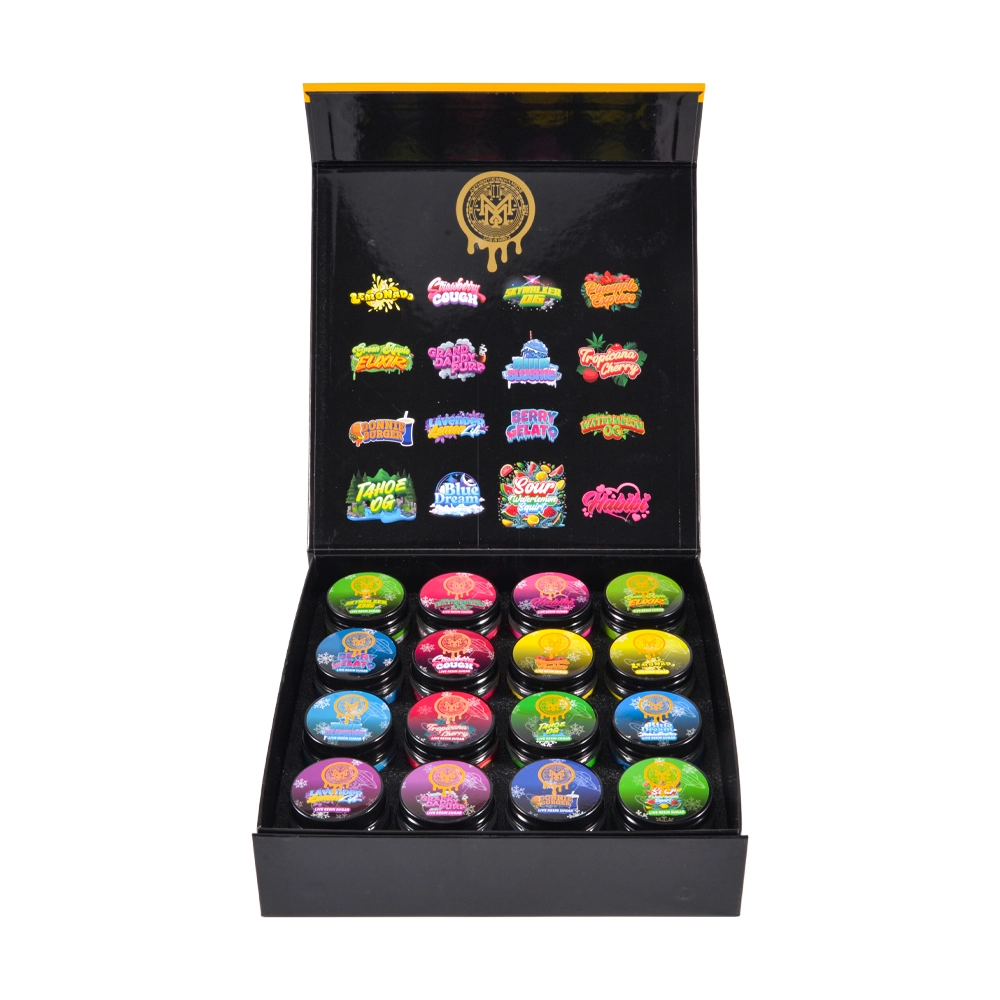
If you’ve browsed dispensary shelves or brand menus, you’ve likely seen Muha Meds flower presented in 1/8-ounce glass jars—a premium look that many buyers now expect for top-shelf nugs. Glass isn’t just aesthetics: it’s about barrier performance, labeling real estate, and compatibility with child-resistant (CR) closures. Understanding the moving parts helps you evaluate any glass-jar program—Muha Meds or comparable formats—before you place a wholesale order or redesign packaging.
What “Muha Meds glass jars” usually mean
In brand catalogs and dispensary listings, the “Muha Meds glass jar” typically denotes a rigid, screw-cap container holding ⅛ oz (3.5 g) flower, paired with a CR closure and tamper-evident feature. That combo supports: (1) a stable aroma profile, (2) consistent visual merchandising, and (3) ample surface for labels (strain name, batch, warnings). California’s regulator explicitly requires child-resistant and tamper-evident packaging traits for cannabis goods, so the jar + CR cap format aligns with that baseline.
Quick compliance snapshot (US perspective)
-
Child-resistant: In California (DCC), all cannabis goods must be sold in CR packaging; the licensee who packages is responsible for meeting the standard.
-
Federal test definitions: CR performance is defined under the Poison Prevention Packaging Act and 16 CFR 1700 testing (child panel + adult use). Many CR jar/closure systems are validated to this protocol or to ISO 8317 for reclosable packs.
-
Other states: Colorado likewise stresses CR + continuing CR after opening for multi-serving packages; check your state’s 2025 rules.
Practical takeaway: when you review a glass-jar spec, ask for CR test reports (16 CFR 1700 or ISO 8317), tamper-evident details, and label space layouts that support state-specific warnings.
Why glass for flower?
Barrier & neutral flavor
Quality glass is prized because it’s chemically robust and, compared with many plastics, less interactive with volatile terpenes. That said, no packaging is perfectly inert in every scenario; coatings, adhesives, and liners still deserve scrutiny. Treat “glass is inert” as a directional statement and evaluate the entire closure system (cap + liner).
Weight, look, and premium cues
Glass gives heft and clarity for visual inspection—useful for shelf appeal at MOFU/BOFU stages. The trade-off is higher freight and breakage risk; you’ll want transport testing on your final shipper setup (see ISTA below).
Closures & liners: the small parts that do the big job
A jar’s performance is often decided by the closure liner. Two common liner families you’ll encounter:
-
Foam (F217/3-ply PE foam): compressible, good taste/odor resistance, widely used; note it does not create a hermetic seal on its own.
-
PTFE-faced liners: excellent chemical resistance and low moisture transmission; often backed by foam for resilience. Useful where aroma retention matters.
What to ask suppliers
Request liner callouts (material, thickness), torque specs for capping, and any migration/odor testing they’ve done. If you’re packaging decontaminated or humidity-conditioned flower, ensure your liner choice supports that moisture target.
Tamper-evidence and label canvas
Compliance teams want obvious tamper-evidence—e.g., perforated neck bands, lidding films, or tear-strip closures—plus room for batch/UID stickers and variable data. California DCC’s guidance calls out tamper-evident and resealable properties; many multi-serving SKUs must remain CR after first opening (mirrored in states like CO).
Shipping & shelf: don’t skip the ISTA piece
Even a great jar/closure can fail in transit without the right shipper and cushioning. For parcel networks, run or request ISTA 3A on the final, shelf-ready package inside its shipper (drop, vibration, compression). Reputable labs and references (ISTA/WESTPAK/Keystone) outline what gets tested and how the results are judged.
State-level labeling & claims discipline
A TOFU rule of thumb: keep your claims focused on packaging performance and regulatory fit. Avoid medical or health language. For California, start with DCC’s packaging page, then layer on state-specific label checklists (warnings, universal symbols, THC statements, etc.). Agency and compliance blogs frequently summarize yearly updates; always reconcile against primary sources.
How this applies when you see “Muha Meds glass jars”
-
Format & capacity: Brand product pages highlight 1/8-oz glass jars for flower—useful as a reference form factor if you’re designing a comparable line or sourcing compatible empties.
-
CR + TE expectations: Treat CR certification and tamper-evidence as table stakes in US markets. Ask vendors for 16 CFR 1700 test summaries (or ISO 8317 certificates) and show how TE is implemented (band, lidding film, etc.).
-
Closure engineering: Specify liner type (e.g., PTFE-faced or foam F217), torque, and capping SOPs to protect aroma and reduce oxygen ingress over shelf life.
-
Transit assurance: Insist on ISTA 3A evidence—or run it on your configured packout—before national distribution.
Buyer checklist (save this)
-
CR documentation: 16 CFR 1700 test report (or ISO 8317) tied to the exact jar/closure SKU; California DCC requires CR at point of sale.
-
Tamper-evidence: Show the tear band, lidding, or seal and where it’s applied in your SOP.
-
Liner selection: Foam (F217) vs PTFE-faced; confirm target humidity and aroma goals.
-
Label real estate: Verify space for state warnings, batch/UID, and variable data.
-
Transport testing: ISTA 3A on your final retail + shipper configuration.
FAQ (TOFU quick answers)
Are glass jars “FDA-approved”?
No. FDA does not “approve” cannabis packaging. For food-contact packaging, FDA issues guidance on chemistry and safety of materials (e.g., coatings, additives), but cannabis packaging compliance is primarily state-level + CR per PPPA/16 CFR 1700.
Is glass totally inert?
Glass is generally stable, but liners, coatings, and adhesives can affect aroma and moisture; choose systems proven for low odor/migration.
What size is common for flower?
⅛ oz (3.5 g) is the most common branded glass-jar format on premium shelves (Muha Meds highlights 1/8th jars for flower).
References (authoritative)
-
CA DCC: Packaging & CRP guidance—child-resistant, tamper-evident, resealable requirements, licensee responsibilities.
-
PPPA / 16 CFR 1700—US CR definitions & testing procedure for special packaging.
-
ISO 8317 (reclosable CR packaging)—globally recognized CR benchmark for jars/closures.
-
ISTA 3A—parcel-distribution simulation for packaged-product integrity (drop, vibration, compression).
-
Material/liner notes—F217 foam and PTFE-faced liners use-cases and limits.
-
Brand context—Muha Meds flower page referencing 1/8th jars.
If you want to more vape wholesale pls go through these pages:muha meds jars|muha meds wholesale|muha meds disposable bulk
0 Comments