
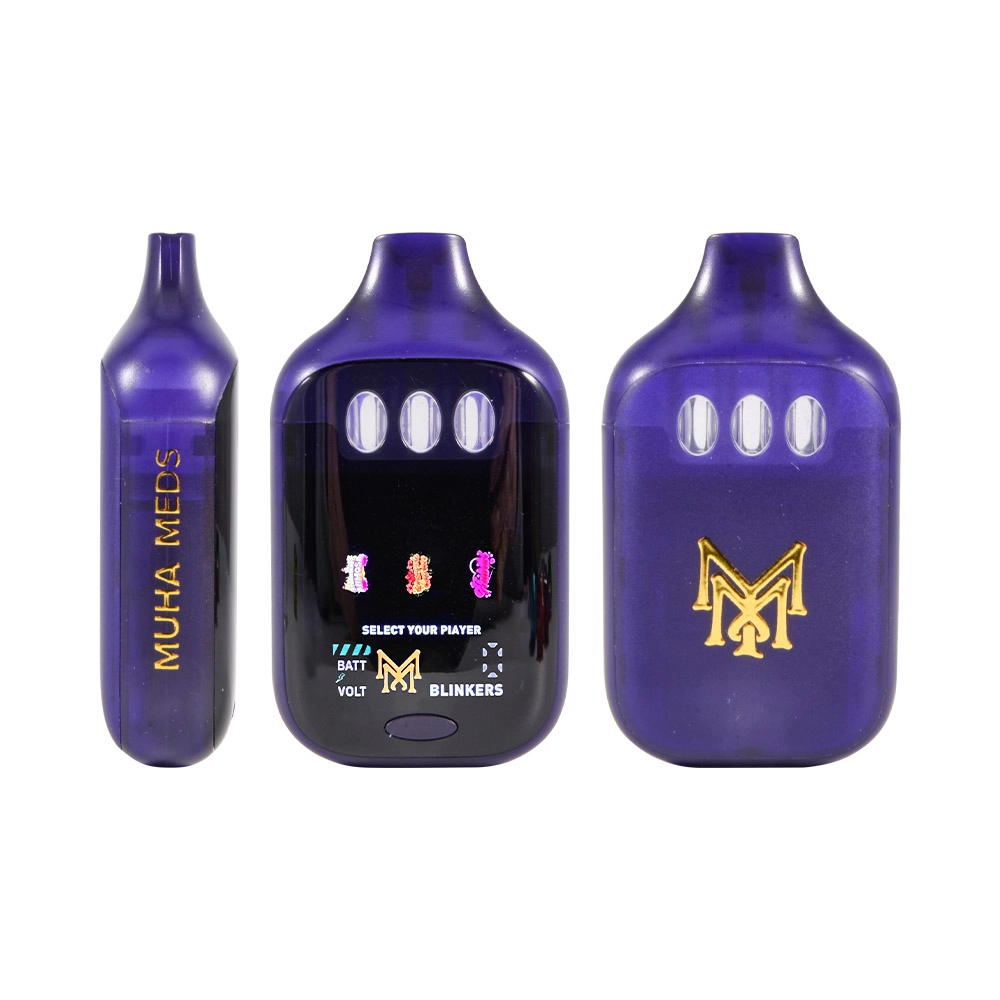
Muha Meds 3-Chamber : Main Features & How It Works
Scope note (hardware-only)
This article is written for B2B buyers sourcing empty hardware. It covers device structure, spec validation, shipping/safety paperwork, and incoming QC—not “effects,” “flavors,” or any controlled-substance content. When you see “Muha Meds 3-Chamber / triple tank” online, treat it as a marketplace descriptor that must be verified at the SKU and batch level (spec sheet + physical QC), not an automatic guarantee of a single official standard.
Key takeaways
-
A 3-chamber (triple tank) disposable is best understood as three separated reservoirs + a switching logic (often via button/UI) feeding a single mouthpiece/aerosol path—exact implementations vary by factory and revision.
-
For bulk procurement, “features” only matter if you can acceptance-test them: screen behavior, mode switching, airflow consistency, resistance window, seal integrity, charging protection, and batch-to-batch variance.
-
Your risk control stack should follow a simple order: (1) verification evidence → (2) shipping/safety documents → (3) incoming QC on the batch—the same framework already used in Vapetech420’s buyer-checklist content.
-
For lithium battery shipments, demand UN 38.3 evidence + a Test Summary (TS) availability path; PHMSA’s TS requirement guidance was revised July 2024, and U.S. hazmat rules around markings continue to evolve (e.g., May 10, 2024 updates).
What is a “3-chamber / triple tank” disposable?
A 3-chamber device generally means the unit has three separate liquid reservoirs (three “tanks”) inside one disposable body. Compared with dual-chamber designs, triple tank adds:
-
More internal sealing interfaces (more potential leak points)
-
A switching mechanism (hardware + firmware/UI) to select a reservoir/mode
-
Higher assembly complexity, which makes QC discipline more important
On Vapetech420, “3 chambers” is also used as a taxonomy for certain products (for example, listings that reference 0.6×3 and LED screen as the selling spec pattern).
Main features (and what “good” looks like in acceptance testing)
LED/digital screen (UI)
What buyers expect: stable display, predictable wake/sleep, and consistent indicators (battery, mode, puff counter—whatever the SKU claims).
Acceptance tests (fast):
-
Wake latency and auto-off timing consistency (sample 10 units)
-
Screen readability at low battery
-
Dead pixels or flicker rate (count defects per 100)
Mode switching (single/dual/triple)
What buyers expect: a clear and repeatable switch pattern (button sequence), no mode “ghosting,” and no accidental switching in pocket.
Acceptance tests:
-
Switch success rate (e.g., 30 toggles per unit × 5 units)
-
Mode persistence after sleep and after charge
Airflow & draw consistency
Triple-tank designs can create uneven airflow because of more internal routing.
Acceptance tests:
-
Draw resistance consistency across samples (subjective + simple airflow jig if you have one)
-
No whistle, no tight/blocked pulls after 10–20 draws
Atomizer resistance window (and stability)
Resistance drift is a common root cause of “burnt taste” complaints and returns (even when hardware is empty, customers may blame your device).
Acceptance tests:
-
Measure resistance on arrival and after a short cycle test (define your own pass band by SKU; document it)
Charging system (USB-C) and basic protections
If you sell battery-powered devices, you should treat battery safety as a procurement requirement, not a marketing line. Standards such as UL 8139 focus on the electrical system (battery/charging/heating controls) of vaping devices, and are commonly referenced in North America safety discussions.
Acceptance tests:
-
Charging current behavior (basic USB meter), heat during charge, port wobble
-
Auto-cutoff at full charge (where applicable per design)
How it works (high-level, non-operational)
A typical triple-tank disposable has:
-
Three sealed reservoirs (independent cavities)
-
A selection interface (button/screen) that routes output logically (implementation varies)
-
A shared aerosol path to the mouthpiece (often merging internally)
-
One battery + control board that manages draw activation, UI, and charging
The key procurement insight: “3 chambers” is not one design—it’s a family of layouts. Two devices can both be “triple tank” while having very different internal seals, airflow geometry, and switching reliability. That’s why your QC protocol must be written around observable pass/fail criteria, not slogans.
Specs to demand from suppliers (B2B-ready checklist)
Ask for a one-page spec sheet that includes, at minimum:
-
Tank configuration: capacity per chamber and total (e.g., “0.6×3” pattern, if applicable)
-
Coil/atomizer: resistance target + tolerance
-
Battery: capacity (mAh), charging port type, charge limits
-
Materials in wetted path (tank material, seals/gaskets)
-
Activation: button/draw, mode switching method
-
Packaging: master carton count, gross weight, labeling approach
-
Revision control: version/date/lot code logic (how you trace batches)
If a supplier can’t provide this as a controlled document, treat that as a leading indicator of downstream variability.
Verification & traceability (don’t rely on a QR alone)
For “brand-style” devices, verification is not just “scan a code.” Your minimum evidence stack should include:
-
PO + invoice + supplier business identity match
-
Lot/box marking rules (what the markings mean)
-
Photo/video of the exact batch in cartons before shipment
-
Verification artifacts (if any) stored in a shared folder with timestamps
This lines up with Vapetech420’s own recommended ordering of checks: verification first, then safety/shipping evidence, then incoming QC on the actual batch.
Internal reading (recommended on your site): Muha Meds 3.5g Empty Disposable: Top 3 Things to Check Before Buying
Shipping & safety documents to request (lithium battery reality check)
If the device contains a lithium battery, your logistics team needs proof that the battery type is transport-compliant.
1) UN 38.3 and Test Summary (TS)
-
UN Manual of Tests and Criteria 38.3 defines the test framework for lithium cells/batteries used in transport classification.
-
PHMSA provides a practical guide on the Lithium Battery Test Summary (TS) requirement, updated July 2024, and references the rule’s effective dates (including revisions effective May 10, 2024).
2) U.S. hazmat rule awareness (markings and transitions)
In the U.S., 49 CFR §173.185 governs lithium cells/batteries for transport. The eCFR text includes May 10, 2024 updates and notes transitional labeling allowances (including continued use of the pre-May 10 mark until December 31, 2026).
3) Air shipping guidance (IATA)
IATA publishes a Lithium Battery Guidance Document (2025 edition) with practical compliance flowcharts and FAQs for shippers working under the IATA Dangerous Goods Regulations framework.
4) Device electrical safety standard references (UL 8139)
UL describes UL 8139 as evaluating the electrical, heating, battery and charging systems of vaping devices; if you sell into markets where retailers ask for a safety story, align your supplier testing narrative to recognized frameworks.
Incoming QC (AQL-style) + quarantine rules
Triple tank adds complexity. Your QC should reflect that with more emphasis on seals and switching.
Suggested incoming QC stations
-
Visual & assembly
-
Housing gaps, screen alignment, port fit
-
-
Seal/leak stress (dry)
-
Pressure/light vacuum test if available; otherwise controlled orientation + time
-
-
Electrical quick checks
-
Charge handshake, current draw sanity, overheating during short charge
-
-
UI & switching
-
Mode changes repeatable, screen stable, no accidental switching
-
-
Resistance sampling
-
Record distribution; watch for wide variance
-
-
Carton/label audit
-
Lot codes, counts, carton integrity
-
Quarantine triggers (stop-ship)
-
Leak rate exceeds your threshold (define per 100 units)
-
Switching failure above threshold
-
Abnormal heating during charge
-
Resistance distribution shifts materially versus approved golden sample
This QC-first discipline is consistent with Vapetech420’s own buyer-check ordering (verification → documents → incoming QC).
3-chamber vs dual-chamber: what changes for buyers?
Where 3-chamber can win
-
More “variety” potential in one body (market demand in some channels)
-
Differentiation for private label catalogs
Where 3-chamber increases risk
-
More seals = higher leak opportunity
-
More firmware/UI complexity = higher switching/returns risk
-
More variance across factories and revisions
Practical guidance: if you don’t yet have a mature QC + returns workflow, dual-chamber is often operationally simpler. Move to triple tank when your supplier validation and incoming QC are already stable.
FAQ (procurement-focused)
1) Is “Muha Meds 3-Chamber” an official standard?
Treat it as a market descriptor unless your supplier provides a controlled spec sheet + traceability evidence for the exact SKU/batch.
2) What is the one document that reduces shipping surprises the most?
A UN 38.3 Test Summary availability path (TS document or hosted link) plus the shipment classification paperwork. PHMSA and IATA both provide guidance on TS handling and compliance expectations.
3) What changed recently in U.S. lithium battery transport rules?
49 CFR §173.185 includes updates effective May 10, 2024 and transitional marking allowances that extend to December 31, 2026 for certain marks.
4) Why do buyers ask about UL 8139?
UL 8139 is a recognized safety standard focused on the electrical systems of vaping devices (battery/charging/heating controls). It’s often used as a credible reference point in safety discussions.
5) What are the top two return drivers for triple tank hardware?
In practice: leaks and inconsistent switching/UI behavior. Design complexity amplifies small assembly variances—so the fix is procurement discipline (docs + QC), not better marketing.
6) How should I write internal link anchor text for this article?
Use natural, descriptive anchors and avoid stuffing keywords into link text—Google explicitly recommends resisting keyword cramming in anchors.
Suggested internal links for Vapetech420 (anchors you can paste)
-
verification, shipping docs, and incoming QC checklist → Muha Meds 3.5g Empty Disposable: Top 3 Things to Check Before Buying
-
empty disposable vape pen catalog → Empty Disposable Vape Pen
-
3-chambers product tag → omakase 3 chambers
Closing: a buyer’s “no-regrets” workflow
If you want triple tank hardware to be a repeatable SKU (not a support headache), run this loop every time:
-
Golden sample approval (documented)
-
Paperwork stack (UN 38.3/TS path + shipping classification)
-
Incoming QC + quarantine rules (written thresholds)
-
Batch variance tracking (resistance, leak, switching defect rate)
That approach maps directly to what Google calls “helpful, reliable, people-first content”—you’re not just describing features; you’re providing a process buyers can execute.
0 Comments