
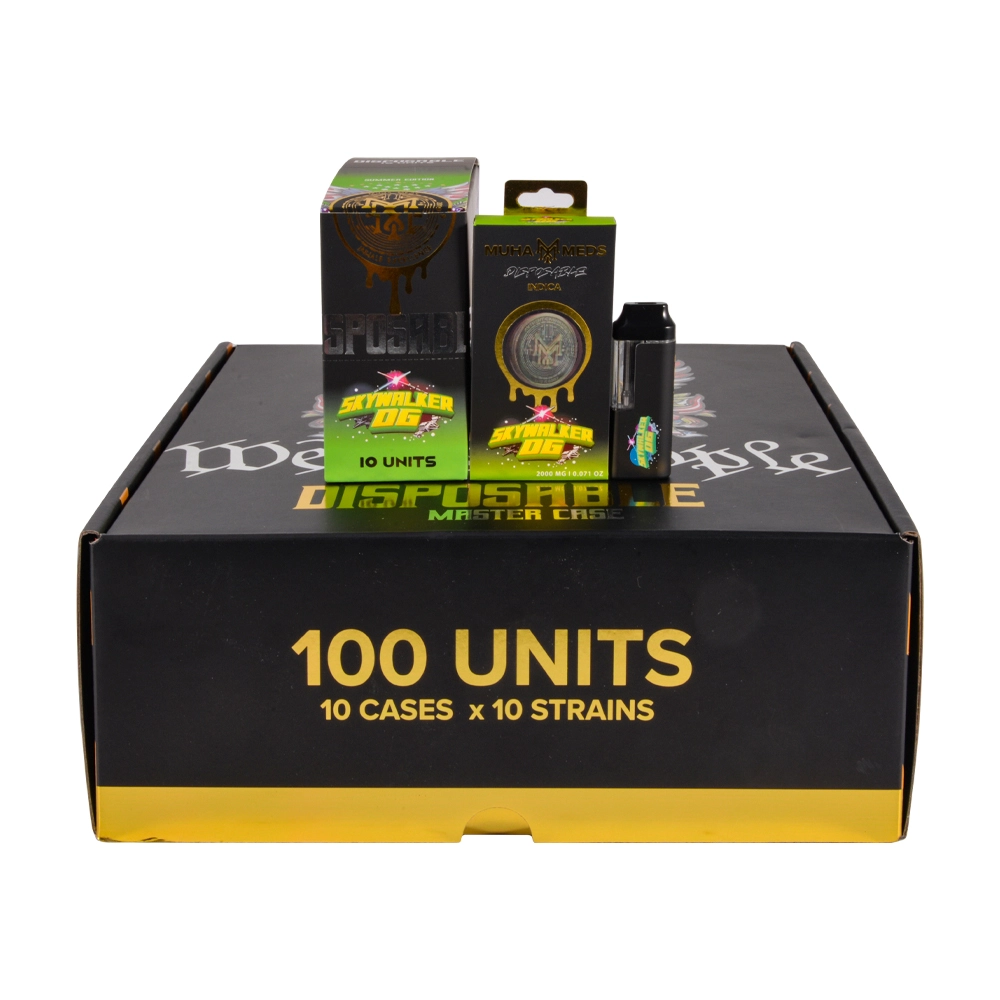
Muha Meds 1g vs 2g Empty Disposable: B2B Battery, Runtime & Charging
Scope: This is a hardware-only guide for empty disposable vape devices (no oil, no THC, no nicotine). It focuses on battery behavior, runtime, and charging for B2B buyers (wholesale, resale, and operations).
Quick Take: 1g vs 2g for Battery & Charging
Who should choose 1g (battery/charging perspective)
- Teams optimizing for smaller form-factor SKUs, lower shipping weight, and fast retail turnover.
- Accounts with strong charging compliance (right cable/charger usage) and lower “support burden.”
Who should choose 2g (battery/charging perspective)
- Teams prioritizing longer use windows, fewer “dead-on-arrival” complaints caused by depleted storage charge, and fewer recharges.
- Accounts that want clearer operational rules for charging behavior and returns triage.
The B2B headline: runtime variance is mostly operations + user behavior
- Device-to-device runtime is driven by battery capacity, cutoff thresholds, draw profile, and charging practices.
- Your biggest lever: standardize incoming QC + publish charging instructions on listings and inserts.
What Actually Changes from 1g to 2g (Electrical View)
Capacity vs load: why “bigger tank” doesn’t automatically mean “double runtime”
- Runtime depends on battery energy (Wh), power draw (W), and cutoff thresholds—not just the “g” label.
- Different editions can use different cells/boards even under the same “1g/2g” naming.
Board + protection: what’s inside that affects charging reliability
- Charging IC behavior (current limit, termination, trickle behavior), protection (OVP/OCP/OTP), and contact design.
- LED patterns often map to voltage/cutoff states—your support team should document them.
What you must confirm on the latest spec sheet (non-negotiables)
- Battery capacity (mAh), charge port type, recommended input (V/A), cutoff voltage, and charge termination indicators.
- Any “fast-charge” restrictions (many small devices should NOT be paired with high-power chargers).
Table to include here: “Muha Meds 1g vs 2g Electrical Snapshot” (capacity, input rating, cutoff/LED behavior, port, typical charge time range, known version notes).
Battery Basics B2B Teams Should Standardize
mAh vs Wh: the conversion your team should use
- Explain why mAh alone is incomplete; standardize on Wh for runtime comparisons.
- State nominal voltage assumption used in calculations (commonly ~3.7V for Li-ion, verify your device specs).
Cutoffs and “it still lights but won’t hit” states
- Low-voltage lockout behavior: device may show lights but disables output to protect the cell.
- Why a device can “charge” but still fail to deliver output (contact resistance, board protection states).
What your listings should say (B2B clarity, fewer returns)
- Recommended charger type, cable type, and what NOT to use.
- Expected charging indicators and typical charge time band (use your tested range, not marketing claims).
Runtime Math You Can Audit (and a Simple Test Plan)
A practical runtime estimation model (with clear assumptions)
- Energy available (Wh) × efficiency factor → estimated usable output.
- Power draw ranges: why draw style (long pulls vs short) changes perceived runtime.
From runtime to “puff count”: how to communicate responsibly
- Why puff count claims vary; use ranges tied to draw duration (e.g., 1.5s vs 3s).
- Recommend communicating “expected recharge frequency” instead of a single puff number.
Test plan for B2B buyers: fast, repeatable, and comparable
- Define sample size per lot, charge-to-full procedure, rest time, and standardized draw protocol.
- Record: charge time, peak device temperature, cutoff behavior, and number of cycles to first complaint.
Tables to include here:
- “Runtime Assumption Sheet” (capacity, nominal voltage, efficiency, estimated Wh, estimated output window).
- “Lot Test Record” (unit ID, charge time, LED pattern, cutoff, anomalies, pass/fail).
Charging Reality: USB-C, Current Limits, and CC–CV
USB-C does not automatically mean “fast charging”
- Explain port type vs charging protocol; many disposables are simple 5V input devices.
- Why high-power adapters can cause heat, early failure, or board protection triggers.
CC–CV behavior in plain language (what users observe)
- Constant-current phase: “charging feels normal.” Constant-voltage phase: “charging slows near full.”
- Why charge time is not linear and why “top-off” can take longer than expected.
Contact and cable physics: the hidden cause of “won’t charge” claims
- Loose port, debris, worn cable, high-resistance cable → voltage drop → device doesn’t enter charge mode.
- Support teams should require a known-good cable test before approving RMA.
Cable/Charger Compatibility Matrix (Reduce Support Tickets)
Recommended combinations (what to tell customers)
- USB-A to USB-C with standard 5V adapters is often the most consistent for simple devices.
- Specify “use a basic 5V adapter” unless your device explicitly supports more.
Combinations to avoid (and why)
- High-wattage laptop/fast chargers when the device is not designed for PD negotiation.
- Damaged/ultra-thin “freebie cables” with unstable resistance.
Policy: what you standardize as an approved charging setup
- Define an “approved charger kit” for internal QC and customer troubleshooting.
- Make it a listing bullet + insert card + support macro.
Table to include here: “Charger/Cable Compatibility Matrix” (USB-A→C, USB-C→C, PD adapters, power banks, car chargers) with “Recommended / Conditional / Avoid” tags and one-line rationale.
Safety, Heat, and Storage Rules That Prevent Failures
Heat is the enemy: what temperatures and behaviors trigger complaints
- Hot charging surfaces, direct sunlight, sealed cars, and stacking cartons reduce reliability.
- Explain why heat increases internal resistance and accelerates capacity loss.
Storage charge and shelf-life behavior (what B2B needs to control)
- Long storage leads to voltage drift; some units arrive “too low” to behave normally.
- Define receiving SOP: random sample check of charge acceptance and cutoff state.
Safe handling policies for warehouses and resellers
- Do not charge unattended; keep away from flammables; isolate damaged units.
- Create a “quarantine bin” process for questionable units.
Incoming QC for Battery & Charging (Acceptance Criteria)
Incoming inspection steps (fast checks)
- Port integrity, indicator light behavior, and physical signs of battery swelling or damage.
- Random cable fit test; confirm stable charging indicator on a known-good setup.
Functional checks (repeatable, measurable)
- Charge acceptance test (start charging within a defined time window), temperature observation, termination indicator behavior.
- Output enable check after partial charge (to detect protection-state issues).
Acceptance criteria + RMA tagging (make returns actionable)
- Define “reject reasons” (won’t charge, overheats, unstable port, inconsistent indicators).
- Tag returns with lot ID, test condition, and failure mode for supplier feedback.
Checklist to include here: “Battery & Charging QC Checklist” (inspection points + pass/fail + notes + photo requirement for failures).
Troubleshooting Playbook (Charge Issues + “Won’t Fire”)
Case 1: “It won’t charge” (decision tree)
- Try approved cable + approved adapter.
- Clean port carefully; check for debris/damage.
- Observe indicator pattern for 60–120 seconds (document it).
Case 2: “It charges but won’t work” (common battery-side causes)
- Low-voltage lockout not fully recovered, contact resistance, or board protection state.
- Short controlled charge then re-test; if still fails, classify as board/protection issue.
Case 3: “It gets hot while charging” (safety-first SOP)
- Stop charge immediately; isolate unit; do not re-attempt with a higher-power charger.
- Record charger/cable used, ambient temperature, and time-to-heat for supplier escalation.
Asset to include here: “Support Macro Pack” (copy/paste scripts for resellers) + a simple “Charge Issue Flowchart” image.
Decision Guide: What to Stock + FAQ + References
Stocking recommendation framework (battery/charging-only)
- If your channel sees many “charging” tickets: prioritize the SKU/version with more stable charge acceptance in your incoming tests.
- If your channel values “fewer recharges”: prioritize the SKU/version with better Wh and lower heat under charge.
FAQ (battery/runtime/charging only)
- Does USB-C to USB-C always work?
- Why does charging slow near full?
- Why can a device light up but not fire?
- What’s the safest charger to recommend for customers?
- How do I reduce DOA claims tied to storage charge?
- What QC checks catch 80% of charging-related failures?
References you should cite (authoritative, non-forum)
- Battery safety & device electrical system safety standards relevant to vaping hardware.
- Li-ion charging fundamentals (CC–CV) and USB-C power basics from engineering-grade sources.
- Transport compliance for lithium batteries (UN38.3-related documentation and guidance).
Closing recap: Summarize the practical difference between 1g vs 2g as “energy + charging behavior + ops discipline,” then list 3 actions: (1) adopt approved charger kit, (2) run incoming QC, (3) publish charging instructions.
If you want to more vape wholesale pls go through these pages:muha meds wholesale|muha meds dual chamber|muha meds bulk 2025
0 Comments