
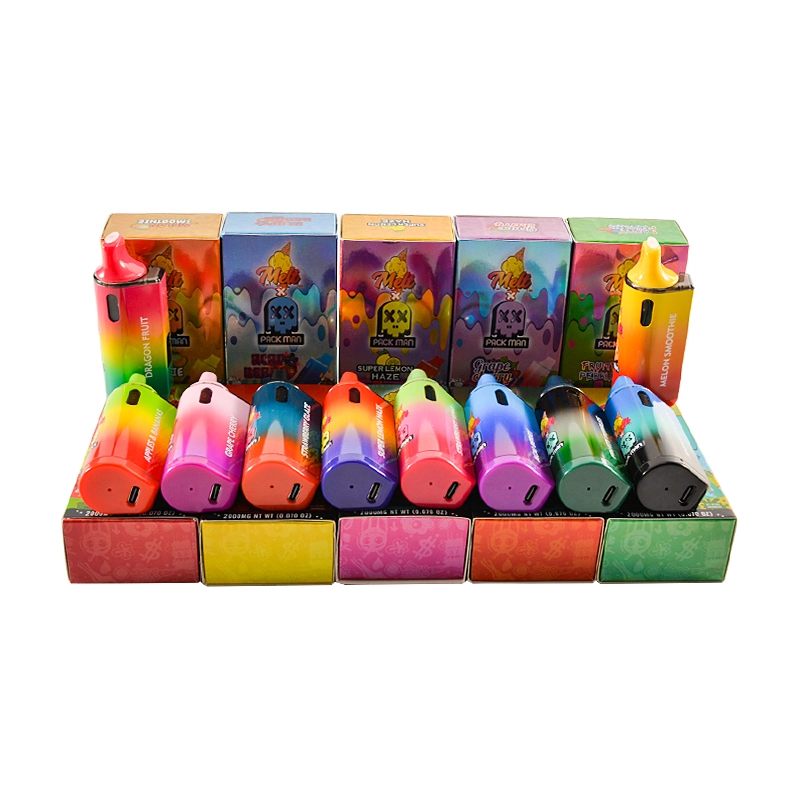
Melt Packman-Style Empty Disposable Vape: A Buyer’s Guide to Safe, Viscosity-Ready Hardware (2025)
Badges: Empty hardware only · No THC/Nicotine · Nominative use only—no affiliation implied
If your team is evaluating Melt Packman-style empty disposables as the shell for thick oils (e.g., live resin/rosin or heavier distillate), the right pick comes down to three things: (1) inlet sizing for viscosity, (2) coil material and geometry, and (3) battery/pack safety and verification. This article maps the decisions, flags the most common failure modes (leaks, clogs, dry hits), and lists the standards and checks your QC should require in 2025.
Quick take: for thick oils, industry-typical inlet ranges cluster around ~1.6–2.0 mm per hole paired with porous/sintered ceramic cores; exact choices should be verified against your oil and OEM datasheets.
1) What “empty disposable” means (and why it matters)
“Empty” = hardware only: mouthpiece, reservoir, atomizer/coil, and a sealed cell with charging/controls when applicable. There’s no filled oil, and you should treat the shell like any other electrical appliance + lithium battery device. That means transport and safety standards apply (even when sold unfilled). For any SKU with a lithium cell, ask the vendor for:
-
UN 38.3 Test Summary (required in transport)—a one-page declaration confirming the cell/pack design passed the UN Manual of Tests and Criteria §38.3.
-
IEC 62133-2 conformance information for portable lithium cells/packs (lithium systems).
-
UL 8139 (2nd ed., 2024) applicability for electronic cigarette/vaping electrical systems.
Requiring these three up-front both de-risks logistics and reduces warranty pain later.
2) Inlet sizing: matching apertures to viscosity
Inlet holes feed oil into the atomizer. Too small → starve/“dry hit”; too large → flooding/leaks (especially with terpene-thin blends). Mainstream ceramic platforms publish menus of inlet diameters (commonly 1.2/1.4/1.6/1.8/2.0 mm), and your OEM can usually customize within that band.
Starting map (pilot-fill and adjust):
| Oil type | Typical inlet range (per hole) | Preferred core | Notes |
|---|---|---|---|
| Distillate (thinner when terpene-rich) | ~1.0–1.2 mm | Porous ceramic | Too-large holes can flood thin blends; start smaller. |
| Live resin | ~1.8–2.0 mm | Porous ceramic | Viscosity varies by strain/age; gentle, even heat helps. |
| Live rosin (thickest) | ~1.8–2.0 mm (sometimes higher) | Porous ceramic | Validate at cold storage temps; pre-warm before testing. |
Why ranges, not single numbers? Because terpene percentage and temperature shift viscosity dramatically. Terpene-rich oils thin out and can overflow through large apertures; colder environments thicken oil and starve small apertures. Your first fills should bracket aperture options and simulate real storage/shipping temps.
3) Coil material: why porous/sintered ceramic dominates thick oils
For thick cannabis oils, porous ceramic is the mainstream choice: capillary pathways pull viscous liquid evenly to the heater, improving flavor stability and reducing burnt hits versus cotton/mesh wicks (which are tuned for thin e-liquids). Multiple technical explainers and brand docs reinforce ceramic’s viscosity tolerance and durability.
At a glance
-
Porous/sintered ceramic: even heat, stable wicking, long service life; slightly slower ramp than mesh. (Best overall for resin/rosin/distillate.)
-
Cotton/mesh: fast ramp, large vapor with thin liquids; with thick oils can flood or starve unpredictably.
-
Quartz/other: niche; prioritize temperature control and cleanliness if used.
4) Metals & materials: what the newest science says (and what to ask vendors)
Recent studies (2024–2025) report nano-sized metal particles (e.g., Ni, Cr, Pb, Sn, Zn) can be present in cannabis vape liquids even before first use, and aerosols can carry metal particles depending on construction and wear. This underscores the importance of hardware metallurgy, coatings, and QA—even for empty shells.
-
The ACS-reported work (2024) and follow-on papers highlight device-origin metals detectable pre-use; unregulated products performed worse.
-
2025 analyses tracking metals from liquid to aerosol (sp-ICP-MS) detected particles of Co, Cr, Ni, Pb, Sn, and Zn in aerosols from tested samples (below LOQ in number but present).
Procurement takeaway: request material declarations (lead-free brass, SUS316L/SS-based wetted parts, protective coatings), plus four heavy-metals screening (Pb, Cd, As, Hg) which most jurisdictions mandate—and consider expanded elemental panels where feasible.
5) Anti-counterfeit & QR verification in 2025
Many buyers prefer Melt/Packman-style branding cues on empty shells. Counterfeit labeling—especially spoofed QR codes—is a growing risk across categories. Two reality checks for your packaging program:
-
Use standards-based codes. Modern QR implementations reference ISO/IEC 18004:2024 (QR symbology), and the retail world is moving to GS1 Digital Link/2D at POS by “Sunrise 2027.” If you plan to route authenticity checks through QR/2D, align your artwork and data model now.
-
Educate teams on QR scams. The FBI’s IC3 warned in July 2025 about unsolicited packages with QR codes used to initiate fraud—always verify the landing domain before entering batch/serial data.
Tip: lock verification to your owned domain; block look-alike URLs; rotate short-lived tokens; and record scan telemetry for audit.
6) Regulatory climate watch (brand-adjacent)
Where cannabis is legal, state regulators actively enforce packaging/labeling and distribution rules. Example: Michigan CRA filed a formal complaint against BUDBRIDGE LLC dba Muha Meds (Oct 29, 2025). If your business references brand-style packaging, keep clear nominative-use disclaimers and validate that your artwork does not imply affiliation.
7) A simple pilot-fill workflow (to cut leaks/clogs by half)
-
Collect datasheets for the exact SKU (aperture count & diameter menu—e.g., 1.2/1.4/1.6/1.8/2.0 mm; core/material; nominal resistance).
-
Bracket fills: test at two aperture sizes (e.g., 1.6 vs 1.8 mm for live resin), same ceramic core.
-
Temperature simulation: condition units at cold (e.g., 5–10 °C), room (20–23 °C), and warm (30 °C) to represent shipping and retail.Log outcomes for 7–14 days: leak %, clog %, returns, and subjective flavor stability.
-
Iterate: adjust inlet or terpene ratio if flooding; pre-warm or increase aperture if starved.
8) Spec sheet: what a robust Melt Packman-style shell typically includes
-
Aperture options: menu spanning 1.2–2.0 mm per hole; commonly 2–4 holes (select per oil).
-
Core: porous/sintered ceramic with even-heat geometry; wickless design.
-
Battery/controls: transportable lithium cell with UN 38.3 Test Summary, IEC 62133-2 safety basis, and UL 8139 electrical systems design where applicable.
-
Packaging/QR: ISO/IEC-compliant QR; plan migration toward GS1 Digital Link patterns by 2027.
-
Metals policy: lead-free wetted path + documented heavy-metals screening; consider expanded panels beyond Pb/Cd/As/Hg.
9) FAQ
Q1: Is 2.0 mm always best for thick oils?
No. It’s a useful upper bound, but your terpene % and storage temperature can push you up or down the menu. Validate under your real-world conditions.
Q2: Do ceramic cores eliminate clogs?
They reduce clog risk by improving capillary feed and heat uniformity, but poor aperture choice, particulates, or cold storage can still cause starve. Pre-warm, filter, and match inlets to viscosity.
Q3: What about QR authenticity?
Use standards-based QR/2D and verify domains. Train staff per the FBI IC3 guidance against spoofed or unsolicited code scans.
If you want more vape wholesale, you can go through those pages: thc vape pen|2 gram disposable|melt packman wholesale|melt x packman dispo wholesale
0 Comments