
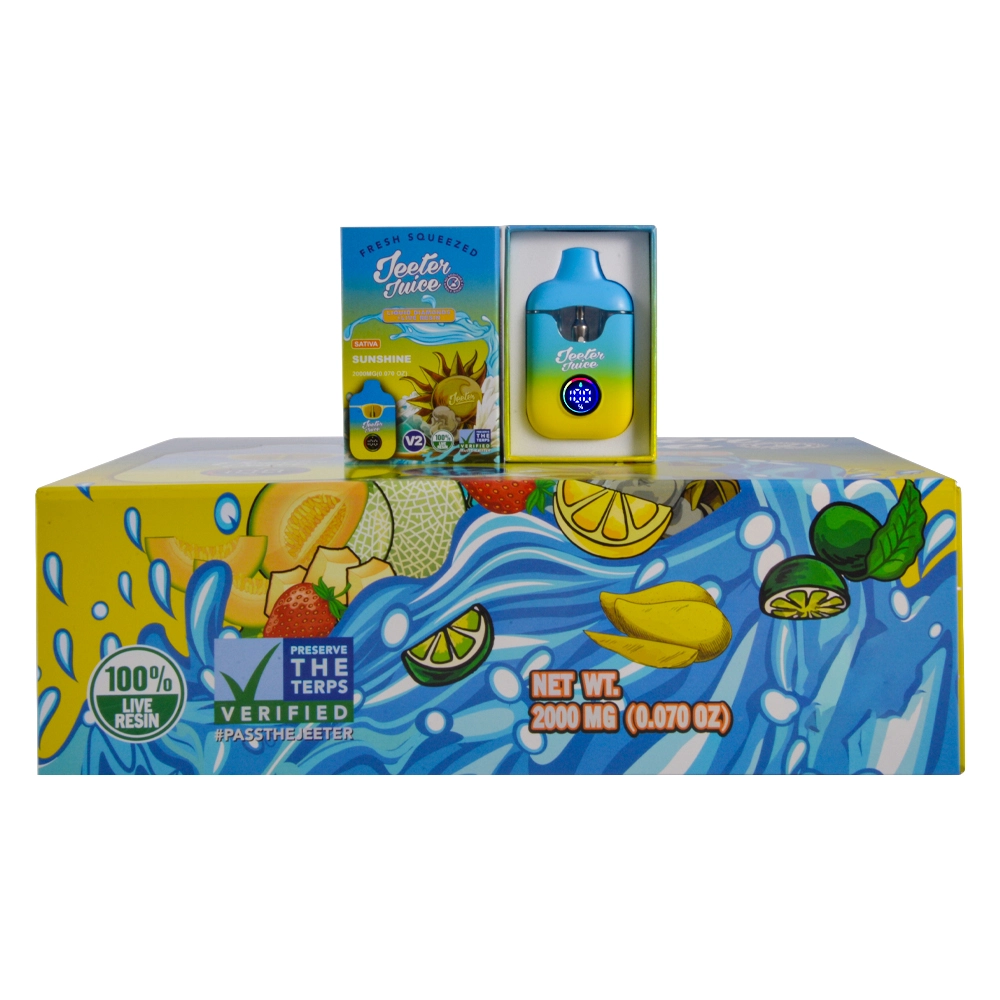
Jeeter Juice V2 Empty Vape Hardware Explained for 2025 Buyers
Short version: Jeeter Juice V2 “empty” means hardware-only. There’s no oil inside. Before anyone inhales, a compatible oil must be filled according to the manufacturer’s instructions, and (if the unit contains a rechargeable cell) the battery may need charging. This page explains what “empty hardware” covers, how it differs from finished (pre-filled) products, and which standards or rules actually apply.
This article does not give medical or legal advice and does not cover claims about nicotine/THC content. Where rules are jurisdiction-specific, we link to the regulator and state the boundary.
1) What “empty” means (scope & boundaries)
-
Empty disposable (hardware-only) = shell + electronics + heater/coil + (sometimes) an integrated rechargeable battery. No oil is included. You (or your contract filler) are responsible for compatible oil selection, filling method, and post-fill sealing/cure as specified by the hardware maker.
-
Finished/retail product = oil is already inside; labeling and testing obligations for the cannabis/nicotine product apply to that finished good (see CA example below). These obligations do not apply to an empty shell.
Why the distinction matters: California’s Department of Cannabis Control (DCC) labeling checklist explicitly applies to “manufactured cannabis products in final form”—i.e., ready for retail transfer/testing—not to empty shells. Don’t copy those finished-good warnings onto an empty-hardware listing as if they were mandatory.
2) Electrical & battery safety: what UL 8139 does (and doesn’t)
If your V2 configuration contains a rechargeable cell, the device-level electrical risks (charging circuit, heater, battery integration) can be evaluated to UL 8139. UL 8139 is a product-safety standard recognized by ANSI/SCC that looks at electrical, heating, battery, and charging systems of vaping devices. It doesn’t certify the consumable (oil/e-liquid) or removable cells. It’s voluntary unless required by a buyer or jurisdiction.
Takeaway for buyers: Ask suppliers whether the exact V2 configuration you’re purchasing has been tested to UL 8139 and request the test report/certificate number. “UL-tested device” ≠ “regulatory approval,” but it’s a meaningful electrical-safety screen.
3) Shipping hardware that includes lithium batteries
If the empty V2 ships with an integrated lithium cell (most do), air and ground logistics have extra requirements:
-
UN 38.3 testing is required for the cell/battery before transport. Since 2023, shippers must make a UN 38.3 Test Summary available (URL or QR accepted) that lists the tested battery, lab, tests, and results.
-
The IATA 2025 Lithium Battery Guidance (aligned with the 66th DGR) explains classifications (UN3480/UN3481), state-of-charge limits for standalone cells, markings/labels, and the correct packing instructions (PI 965–970). Airlines may impose stricter policies.
Buyer checklist: confirm your supplier provides the UN 38.3 test summary for the exact battery model and packs/marks shipments per IATA 2025 if flying cargo. If you order without batteries, these battery-transport rules generally don’t apply.
4) CR/TE packaging: use the legal terms correctly
“Child-resistant (CR)” and “tamper-evident (TE)” have legal meanings in the U.S. Under the Poison Prevention Packaging Act (PPPA) and 16 CFR Part 1700, CR means significantly difficult for children under 5 to open (with quantified pass rates in protocol testing), while remaining usable for adults. Avoid the marketing term “child-proof.”
-
Empty hardware may be sold in CR outer cartons/components by choice or distributor requirement, but CR mandates typically target hazardous substances or finished cannabis/nicotine products. Check your state program rather than assuming a universal rule.
5) Labeling: finished products vs. empty shells (California example)
-
The DCC’s labeling explainer and 2024 checklist (PDF) specify what must be printed on finished manufactured cannabis products (e.g., ingredients, government warning, cannabinoid content, batch/UID). A QR webpage does not replace on-package requirements. These requirements activate when oil is inside and the product is in final retail form—not at the empty-shell stage.
6) QR codes: verify safely (FTC guidance)
If your empty hardware packaging includes a QR code (for authenticity, manuals, or UN 38.3 summary), scan safely. The U.S. FTC warns that “quishing” scams place fake QR codes on stickers or unexpected packages to harvest credentials or push malware. Only scan codes on sealed, official packaging; check the domain; never enter personal data on unfamiliar sites.
7) How to use empty hardware (no contradictions)
This is hardware-only. Do not inhale until the device is correctly filled and closed.
Filling (high-level overview):
-
Inspect the empty unit and closure parts per the maker’s IFU (instructions for use).
-
Fill with a compatible oil/viscosity using the recommended syringe/filling jig and target temperature (if applicable).
-
Install the final cap/closure to spec; many designs require a one-time press-fit that becomes non-removable.
-
Observe any rest/cure time the manufacturer recommends to saturate the coil/wick and equalize pressure.
-
Only then should an adult user test one gentle priming draw.
-
If your V2 variant includes a rechargeable battery, charge it per the IFU before first use; never leave charging unattended. (UL 8139 covers electrical system evaluation, but users must still follow safe-charging practices.)
Maintenance: Empty disposables are designed for low maintenance after filling and sealing, but the charging port (if present) should be kept clean/dry. Replace the unit when performance declines or the oil is exhausted. Never “open-and-inhale” an unfilled device.
8) Model-specific features (avoid over-promising)
Specs like capacity (e.g., 2 g or stated mL volume), USB-C, auto-draw, or display/LED are model/batch-specific and should be confirmed on the product datasheet or licensed reseller listing. Note that g (mass) and mL (volume) are not interchangeable; oil density varies. When in doubt, publish the manufacturer’s spec sheet rather than a generic claim.
9) Buyer checklist (copy/paste friendly)
-
Empty = hardware-only. No oil; never inhale until filled/closed per IFU.
-
Electrical safety: ask for UL 8139 test evidence for the specific configuration (if it has a rechargeable cell).
-
Battery shipping: get the UN 38.3 test summary link for the exact battery and follow IATA 2025 packing/marking if shipping by air.
-
CR/TE wording: use PPPA / 16 CFR 1700 terms correctly; avoid “child-proof.”
-
Finished-good labels ≠ empty hardware. Use the DCC checklist only as a comparison when discussing filled products in CA.
-
QR safety: scan only sealed, official codes; verify the domain; beware quishing.
FAQs
Q1. Is UL 8139 mandatory?
No. It’s a voluntary safety standard many buyers require. It evaluates the electrical, heating, battery and charging systems—not the oil. Ask for documentation.
Q2. Do I need UN 38.3 and IATA paperwork for sample shipments?
If your empty hardware ships with lithium batteries, yes—UN 38.3 test summary accessibility plus IATA 2025 marking/packing when flying. If you ship without batteries, battery-specific rules generally don’t apply.
Q3. Are CR/TE packages required for empty shells?
PPPA defines CR packaging and how it’s tested; mandates vary by substance and jurisdiction. Many CR/TE mandates target finished products. Check your state program.
Q4. Does a QR page replace on-box labeling?
No. In CA, DCC says finished products must carry required info on the package; QR pages are supplemental. Empty hardware isn’t a finished product.
Q5. Can I write “2 g / 2 mL” interchangeably?
No. g measures mass; mL measures volume. Density varies by formulation, so don’t treat them as equivalents.
References (authoritative)
-
UL — E-cig & vape electrical certification (UL 8139 scope; ANSI/SCC recognition) and news explainer on what UL 8139 covers/doesn’t.
-
IATA (2025) — Lithium Battery Guidance Document (test summary, marking/packing, examples) and program page for 66th DGR; passenger guidance.
-
UN 38.3 — Test Summary requirement referenced in IATA 2025 (examples provided in the guidance document).
-
CPSC / eCFR 16 CFR Part 1700 — PPPA CR definition & effectiveness criteria.
-
California DCC — Finished-goods labeling explainer + 2024 checklist (PDF) (comparison only; not for empty shells).
-
FTC — 2023 & 2025 QR (“quishing”) consumer alerts.
If you want to know more wholesale Jeeter Juice Pls go through these pages:jeeter juice disposable|jeeter cartridge|Jeeter Disposable
0 Comments