
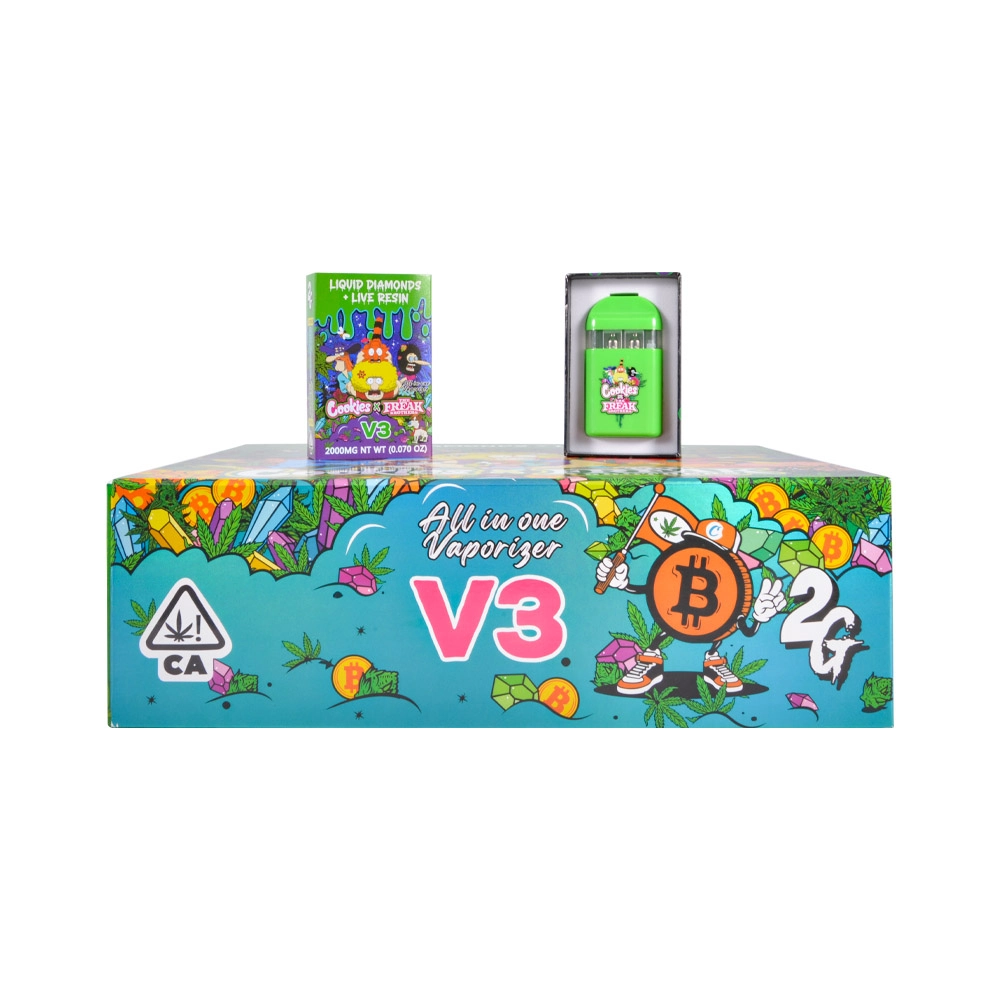
Cookies x Freak Brothers V3 Specs Explained: 1ml+1ml, LED Screen, Type-C, and Switch Modes
Scope note (B2B / hardware only): This article discusses empty, unfilled Cookies x Freak Brothers V3–style dual-chamber hardware (no oil, no nicotine, no THC/CBD). Specs and button logic can vary by batch, supplier, and firmware—use the checklists below to lock in your exact build before scaling.
Quick spec snapshot (what’s most commonly listed)
Across multiple wholesale listings for “Cookies x Freak Brothers V3 / V3 Switch,” you’ll usually see the same core spec set:
-
Capacity: 2.0 ml total via 1.0 ml + 1.0 ml dual chamber
-
Charging: Type-C
-
Display: LED/LCD screen (implementation varies)
-
Operating voltage / resistance (commonly listed): ~3.4V and ~1.4Ω on several V3 pages
-
Battery capacity (often inconsistent across sellers): you may see ~260mAh, 300mAh, 380mAh depending on listing
Why this matters for buyers: The “headline” features are stable (dual chamber 1ml+1ml, screen, Type-C), but battery rating and even click-logic can differ across batches. Build your PO around your verified sample, not generic marketing specs.
1ml + 1ml dual-chamber: what it actually means
A “1ml+1ml” device is essentially two separate reservoirs in one body. On most V3 listings, that totals 2ml capacity and supports switching between chambers (or running both, depending on mode).
What to verify on your sample (before you scale):
-
True separation: chambers are isolated (no flavor bleed) when only one side is active.
-
Airflow consistency: each chamber pulls within an acceptable variance (avoid “one side tight, one side airy”).
-
Chamber indicator behavior: screen/icon/light reliably tells the operator which side is active. Some sellers describe indicator colors.
LED screen: what it’s for (and what to test)
Listings generally advertise an LED/LCD screen, but they don’t always agree on what’s shown. At minimum, screens are used to reduce “mystery problems” (dead battery vs. mode confusion), which can lower returns and support tickets.
Inbound QC tests (fast, practical):
-
Segment test: confirm every segment/pixel can light (no dead corners).
-
Brightness + viewing angle: quick check under warehouse lighting.
-
Mode synchronization: screen accurately updates when switching chambers/modes.
-
Adhesion & window fit: no light leaks, fogging, or loose lens.
Buyer tip: Ask your supplier for screen version control (e.g., “Screen UI V3.1”), and require that the carton label matches the UI version used in the shipped batch.
Type-C charging: what B2B teams should confirm
“Type-C” is widely listed for V3 hardware.
For buyers, the key is not just the port type—it’s port robustness and charging stability.
What to verify (simple but high impact):
-
Port alignment: plug inserts smoothly; no “angled” fit.
-
Charge acceptance: device charges from common USB-C power sources (and doesn’t require a picky cable).
-
Heat check: 10–15 min charge spot-check (no abnormal heat at the port or body).
-
Mechanical durability: sample a small cycle test (insert/remove) if you’re doing high-volume distribution.
Switch modes & click logic: don’t assume—lock it down
Many V3 listings publish a click map like:
-
5 clicks: power on/off
-
1 click: switch chamber/flavor
-
2 clicks: dual-chamber / both flavors
-
3 clicks: preheat cycle
That exact mapping appears on at least one detailed V3 spec page.
However, other pages describe different mappings, which is a real-world sign of firmware variance (or listing errors). For example, one blog-style page swaps the functions assigned to 2 vs. 3 clicks.
What you should do (this is the “authoritative” way):
-
Perform a 60-second function test on your approved sample.
-
Photograph/video the screen behavior per click pattern.
-
Freeze the click map in your PO + carton insert (“Operator Card”).
-
Require “no firmware change without written approval.”
If your supplier describes a single-press switching system with indicator colors, validate that it matches the units you receive.
Why battery ratings vary (260 / 300 / 380 mAh) — and how to prevent surprises
Across common V3 listings, battery capacity is not consistently reported (you’ll see different mAh values depending on the seller).
This can happen because:
-
Different factories produce “V3-style” shells under similar naming.
-
Battery sourcing changes (cell vendor swap).
-
Marketing pages reuse templates from older runs.
Batch-control approach (simple, scalable):
-
Require the battery model (if available) and mAh on the spec sheet.
-
Add an inbound check: weigh-range + charge-time sanity on random samples.
-
Keep a “golden sample” per approved batch for comparison.
Compliance & shipping: don’t skip UN 38.3 documentation
If your hardware includes lithium cells/batteries, shipping and downstream distribution often requires that the battery design has passed UN 38.3 tests, and supply chain partners may request a lithium battery test summary.
-
PHMSA’s guidance explains that manufacturers and subsequent distributors must make available a test summary with standardized elements (and notes revisions effective May 10, 2024 for certain exceptions).
-
IATA’s guidance similarly emphasizes that lithium cell/battery types must have passed UN 38.3 tests to be permitted in transport (within the context of devices using lithium power sources).
Procurement checklist (ask for these up front):
-
UN 38.3 Test Summary (TS)
-
Battery spec (model / Wh rating where applicable)
-
Packing declaration support (your forwarder may request details)
This paperwork is one of the fastest ways to separate “ready for scale” suppliers from risky ones.
Buyer-ready QC checklist (minimum viable, catches most problems)
A. Appearance & build
-
Housing integrity, seams, mouthpiece fit
-
Screen window alignment, no scratches
-
Port alignment + no wobble
B. Function
-
Power on/off works reliably
-
Chamber switching consistent
-
Screen updates correctly
-
Preheat cycle triggers correctly (timing consistent)
C. Performance sanity
-
Airflow: no blocked pulls, no extreme variance left vs right chamber
-
Resistance spot checks if you have a meter (compare to approved spec range)
D. Packaging & receiving
Some V3 listings explicitly mention a packout like device + boxes + stickers + master carton—make sure your receiving team has a documented pack plan and counts match the PO.
If you want more vape wholesale , you can go through those pages: empty disposable vape|2ml disposable|cookies x the freak brothers wholesale|wholesale cookies x the freak brothers disposable
0 Comments