
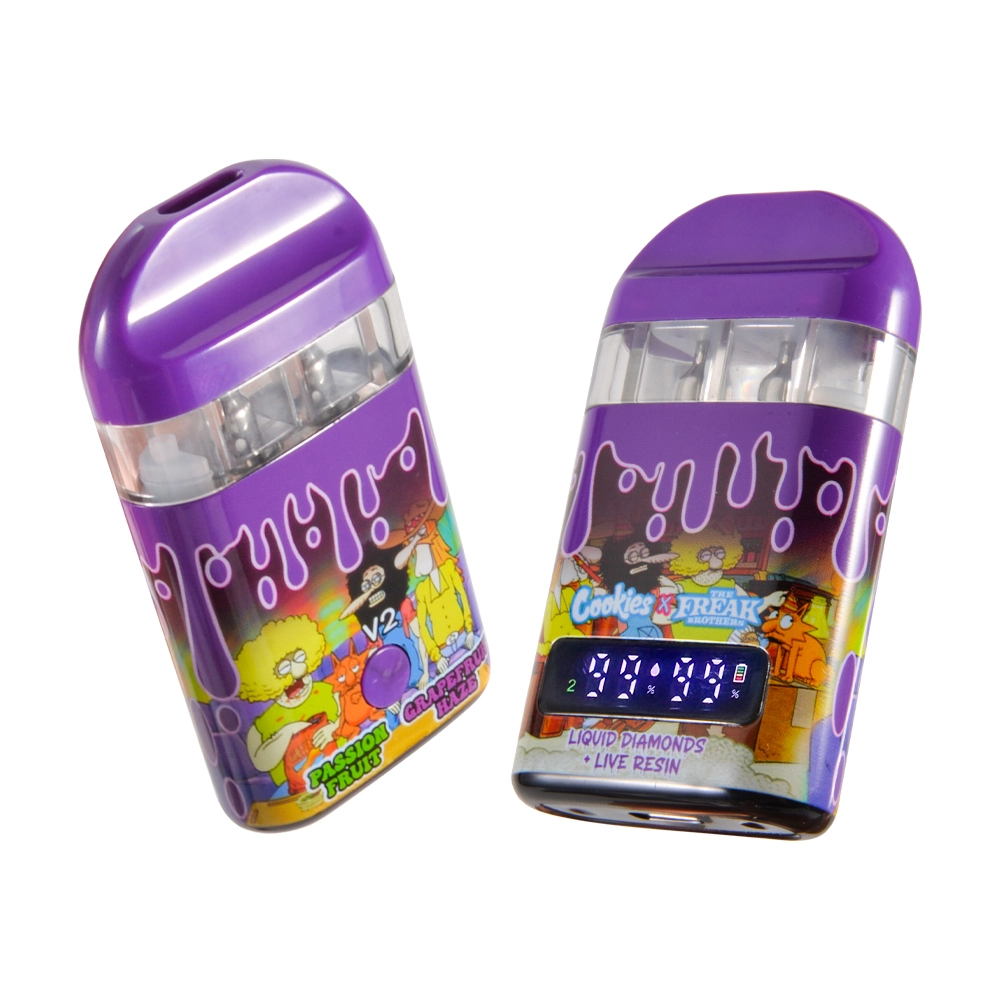
Scope & audience. This guide explains the hardware only aspects of “Cookies X Freak Brothers”-style 2-gram disposable shells (no oil included). It’s for licensed fillers and B2B buyers comparing device features, safety basics, and applicable U.S. handling/labeling frameworks that often surround finished cannabis goods. It is not legal advice, nor does it promote consumer use. For finished/filled products, always follow your jurisdiction’s rules and the brand owner’s official instructions.
What “empty hardware” means (and why it matters)
An empty disposable shell ships without oil. It typically includes: a housing, mouthpiece, sealed reservoir, heating element (often ceramic), airflow path, and a rechargeable lithium-ion cell (commonly USB-C). Empty shells must be filled, capped/closed (or welded/ultrasonically sealed, per design), and post-fill tested by a licensed manufacturer before any consumer sale. That’s different from prefilled retail disposables, which are already dosed, labeled, and tracked under state cannabis rules. For U.S. compliance, the finished cannabis item—not the empty shell—triggers most DCC/state labeling and testing rules.
Core hardware features buyers compare in 2025
-
Capacity: 2 g class reservoir (often specified as ~2.0 mL).
-
Power/charging: Embedded Li-ion cell with USB-C charging (buyers should request UN 38.3 test summaries for the cell/pack from the factory).
-
Atomizer: Porous ceramic with inlets sized for live resin/distillate viscosities (check oil hole size and resistance).
-
Controls: Draw-activated; some variants add LED/mini display for battery indicator and puff counter (for device status only—consumer THC measurement is not a feature).
-
Seals: Tamper-evident mouthpieces or ultrasonic welds after fill; leak-resistant gaskets and anti-condensate airway geometry (varies by model).
Tip for fillers: ask the OEM for viscosity windows and recommended preheat/voltage ranges; validate with your own bench and stability tests before scale-up.
Safety & transport frameworks that touch the hardware
-
Battery transport (air/ground). Lithium batteries used in the devices should meet UN 38.3 (transport tests) and ship per IATA/ICAO & 49 CFR rules (proper UN numbers, packing instructions, SOC limits, marks/labels). Obtain the UN 38.3 test summary from the cell/pack supplier; if shipping by air, consult the IATA Dangerous Goods Regulations and the Lithium Battery Guidance.
-
Device electrical safety. UL 8139 is a recognized safety standard evaluating electrical/heating/battery systems for e-cig/vape devices; while not a law, many buyers spec it as a design-safety benchmark in North America. Ask for the device’s UL 8139 report or certification status and confirm the test lab.
-
Finished cannabis goods testing & labeling (state level). Once filled in California, cannabis goods must be lab tested (COA) and labeled per DCC rules before sale; labs report cannabinoids, residues, heavy metals, microbials, etc. Empty shells alone are not the tested “cannabis goods,” but your finished product must comply.
-
Device/e-waste disposal. For retail customers and dispensaries, spent disposables and nicotine-contaminated materials can enter hazardous waste streams; lithium cells require e-waste handling. Build customer instructions and trade-back options with local e-waste programs.
Authenticity, QR risks, and verification hygiene
Counterfeiting remains a market risk. If your program includes QR or scratch-off codes on finished goods, teach buyers end-user QR hygiene: criminals increasingly weaponize QR links. Direct users only to official brand or state-licensed lab portals, and beware of unexpected QR stickers/redirects (phishing/malware).
For U.S. retail channel verification (California example), partner with licensed retailers and state-tracked distributors; DCC maintains public resources describing licensing/testing regimes and where businesses are allowed.
Filling & commissioning (for licensed manufacturers)
Do not inhale an empty device. Empty shells require:
-
Fill with qualified oil at validated temps/viscosity;
-
Cap/close per OEM instructions;
-
Settle (soak) time for wick saturation;
-
Functional checks (draw resistance, leak, electrical);
-
Labeling/track-and-trace per state rules (when applicable to finished goods). California-bound goods must complete COA testing prior to sale/transfer.
Spec checklist to request from the hardware OEM
-
Material contact declaration (metals, ceramics, seals), extractables/leachables summary.
-
Atomizer resistance (Ω), inlet dimensions, recommended voltage/preheat map.
-
Battery pack details: capacity (mAh), cell model, UN 38.3 test summary, any IEC 62133-2 data; charger protections.
-
Quality controls: leak/pressure tests, incoming cell QA, and 100% EOL tests (draw sensor, LED/screen, charge).
-
Packaging: tamper-evident components and shipping configuration compatible with dangerous goods rules (if batteries are installed).
Labeling: what applies to finished vs empty
-
Finished cannabis vaporizer (CA): Must carry state-required warnings, cannabinoid facts, batch/UID, lab info, and disposal statements per DCC regulations; goods cannot be sold until lab results are recorded (COA + track-and-trace).
-
Empty shell: Typically outside DCC labeling scope until filled; still, B2B packaging should remain tamper-evident and child-resistant where required by state consumer-product rules or general safety statutes in your channel. (Buyers should confirm requirements in each destination state.)
Basic troubleshooting after fill (for factories & licensed fillers)
-
Harsh/“dry” hits → increase post-fill soak time; verify oil viscosity vs inlet size; check preheat/voltage within OEM window.
-
Flooding/leaks → lower fill temp/volume tolerance; confirm seal torque/weld; audit gasket durometer.
-
No-fire/auto-draw issues → verify sensor port alignment; EOL sample more units for sensor drift; check charger lead dress.
Responsible retail partnerships (California example)
-
Source only through licensed distributors/retailers and ensure your finished goods follow lab-testing and labeling rules; DCC pages outline requirements and provide contacts.
-
Avoid “lowest-price” channels with no traceability. Train staff on QR risks and direct them to official verification endpoints only.
Quick buyer FAQ (hardware only)
Q: Can the LED/LCD display show THC strength?
A: No. Consumer devices display device status (battery/puffs/temperature modes). Cannabinoid potency is established by lab COA on the filled batch, not by the hardware.
Q: Is UL 8139 legally required?
A: It’s not a statute, but a widely recognized safety standard many buyers specify for electrical/battery risk reduction in e-cig/vape designs.
Q: What documents should accompany battery shipments?
A: UN 38.3 test summary for the cell/pack, plus IATA/49 CFR compliant marks, packing instructions (e.g., PI 965–970 families), and SOC limits as applicable.
Q: How should spent devices be handled at retail?
A: Use local e-waste/battery take-back; avoid landfilling. EPA notes vape wastes (incl. nicotine residues and lithium batteries) can fall under hazardous waste controls.
Sources & reference spots (selected)
-
DCC (California) — testing/COA, licensing ecosystem, and where cannabis businesses can operate.
-
California cannabis regulations (Title 4 draft/compiled) — packaging/labeling frameworks relevant to finished goods.
-
UL 8139 (device electrical safety) — scope/overview.
-
UN 38.3 (lithium battery transport tests) — test summary requirement.
-
IATA Dangerous Goods / Lithium Battery guidance — air shipping rules.
-
QR-code fraud advisories — FBI IC3 PSA & FTC guidance.
-
EPA—vaping waste — environmental handling.
0 Comments