
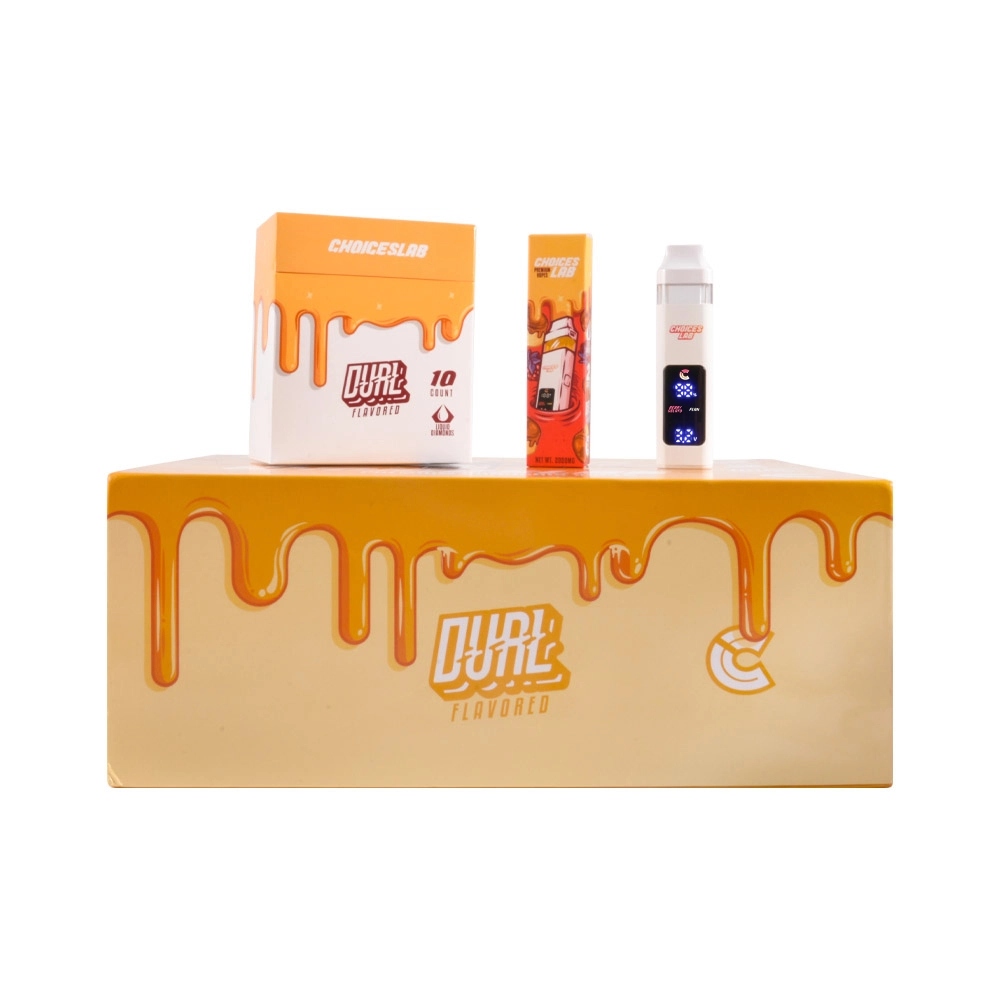
If you’re shortlisting Choices Lab-style empty disposables as your shell for thick oils (live resin/rosin or heavier distillate), three decisions drive real-world performance and returns rate: (1) inlet sizing vs. viscosity, (2) coil material/geometry, (3) compliance & verification. This guide gives you a practical map—with ranges (not one “magic” spec), a validation workflow, and the standards your QC team should be asking vendors for in 2025.
Quick take: For thick oils, industry-typical inlet ranges cluster around ~1.6–2.0 mm per hole and pair best with a porous/sintered ceramic core. Major platforms publish configurable menus at 1.2/1.4/1.6/1.8/2.0 mm—start in range, then validate on your oil and temps.
1) What “empty disposable” means (and why it matters)
“Empty” means hardware only—mouthpiece, reservoir, atomizer/coil, and a sealed Li-ion cell/charging when applicable—no filled oil. Treat the shell like any other electrical product + lithium battery, which brings real safety and transport obligations. Before you move a rechargeable shell, request from the vendor:
-
UN 38.3 Test Summary for the cell/pack (global transport requirement; updated PHMSA guidance in 2024). IEC 62133-2 basis of safety for portable sealed Li-ion cells/packs.
-
UL 8139 evaluation of the electrical system (battery, charging, heating) for e-cig/vape devices.
Requiring these up-front prevents expensive logistics holds and lowers warranty risk later.
2) Inlet sizing: match apertures to viscosity (range, not a single number)
Inlet holes meter oil into the core. Too small → starve/dry hits; too large → flood/leaks (especially with terpene-thin blends). Leading ceramic platforms document configurable hole menus (commonly 1.2–2.0 mm) and encourage matching to your oil.
Starting map (pilot-fill and adjust):
-
Distillate (thinner when terpene-rich): ~1.0–1.2 mm per hole.
-
Live resin: ~1.8–2.0 mm per hole.
-
Live rosin (thickest): ~1.8–2.0 mm (sometimes higher) per hole; confirm at cold temps.
Why ranges? Terpene % and temperature swing viscosity. Terpene-rich blends can flood in large apertures; cold storage thickens even “good” setups and can starve the coil unless you pre-warm or step up hole size.
3) Coil material: why porous/sintered ceramic is the mainstream choice for thick oils
For cannabis extracts, porous/sintered ceramic remains the most reliable core: capillary micro-channels feed viscous oil evenly and allow gentler, uniform heating—cutting harsh hits and preserving flavor—while cotton/mesh wicks are tuned for thin e-liquids and are prone to flooding or starving with thick oils.
-
Ceramic: even heat, stable wicking, long service life (best overall for resin/rosin/distillate).
-
Cotton/mesh: fast ramp & big vapor with thin liquids; unpredictable with thick oils.
4) Materials and metals: what the newest research signals for hardware buyers
Recent peer-reviewed and institutional reports (2024–2025) flag device-origin metal particles detectable in liquids pre-use and in aerosols—with variability by construction and metallurgy. This doesn’t condemn all devices; it tells procurement to prioritize material declarations + testing even for empty shells.
-
ACS press release (2024): nano-sized toxic metal particles found in cannabis vape liquids before heating; issues worse in unregulated products.
-
2025 sp-ICP-MS study: particles (Al, Co, Cr, Cu, Ni, Sn, Zn) tracked from liquid to aerosol in tested samples.
Procurement takeaway: ask for wetted-path metallurgy (e.g., lead-free brass, SUS316L) and heavy-metals screening (Pb, Cd, As, Hg at minimum)—many jurisdictions already require these four, and expanded elemental panels are increasingly common.
5) Anti-counterfeit & QR: standards you can lean on (and a scam to avoid)
If you personalize shells or cartons, plan your codes on real standards:
-
ISO/IEC 18004:2024 defines the QR symbology itself.
-
GS1 Digital Link + Sunrise 2027: retail is migrating toward 2D barcodes at POS by end-2027; align art/data now so your codes remain interoperable.
Also brief your team on QR-brushing scams (unsolicited packages with QR codes). The FBI’s IC3 issued a 2025 PSA: don’t scan unknown codes; verify landing domains before entering batch/serial data.
6) A simple pilot-fill workflow (to halve leaks/clogs in real deployments)
-
Collect the datasheet for the exact SKU: hole diameter & count (e.g., menus at 1.2/1.4/1.6/1.8/2.0 mm), core type, and nominal resistance.
-
Bracket fills on two aperture sizes (e.g., 1.6 vs 1.8 mm) with the same ceramic core.
-
Temperature simulation: condition units at cold (5–10 °C), room (20–23 °C), warm (30 °C) to mirror shipping/retail environments.
-
Log leak %, clog %, returns, and sensory notes for 7–14 days; then tune aperture or terpene ratio accordingly.
7) Spec sheet: what a solid Choices Lab-style shell typically includes
-
Aperture options: menu 1.2–2.0 mm per hole; 2–4 holes available; OEM can customize.
-
Core: porous/sintered ceramic for viscous oils.
-
Battery & electrical safety (if rechargeable): UN 38.3 Test Summary + IEC 62133-2 basis + UL 8139 electrical systems evaluation.
-
QR/2D codes: ISO/IEC-conformant QR; roadmap to GS1 Digital Link / Sunrise 2027 for retail-grade interoperability.
-
Metals policy: documented Pb/Cd/As/Hg screening (consider expanded panels); prefer lead-free wetted path steels/brasses.
8) FAQ
Q1: Is 2.0 mm always the right inlet for thick oils?
No. It’s a common upper-range choice, but terpene % and storage temperature change viscosity. Validate under your real conditions; many live resin/rosin programs land 1.8–2.0 mm.
Q2: Do ceramic cores eliminate clogs?
They reduce risk via capillary feed and even heat, but cold storage, particulates, or mismatched apertures still clog. Pre-warm, filter, and size inlets to the oil.
Q3: What should I ask my vendor before PO?
Current datasheet (holes, core, resistance), UN 38.3 summary, IEC 62133-2/UL 8139 applicability, metals screening, and a pilot-fill window for tuning.
Final word
A Choices Lab-style empty disposable can deliver stable flavor and low returns if you treat the spec as a range + validation problem—size inlets to viscosity, insist on porous ceramic, and require battery/materials compliance and standards-based QR. That’s the 2025 buyer playbook.
If you want more vape wholesale,pls go through those pages:|2 grams disposable wholesale|choices lab wholesale|choices lab disposable fake
0 Comments