
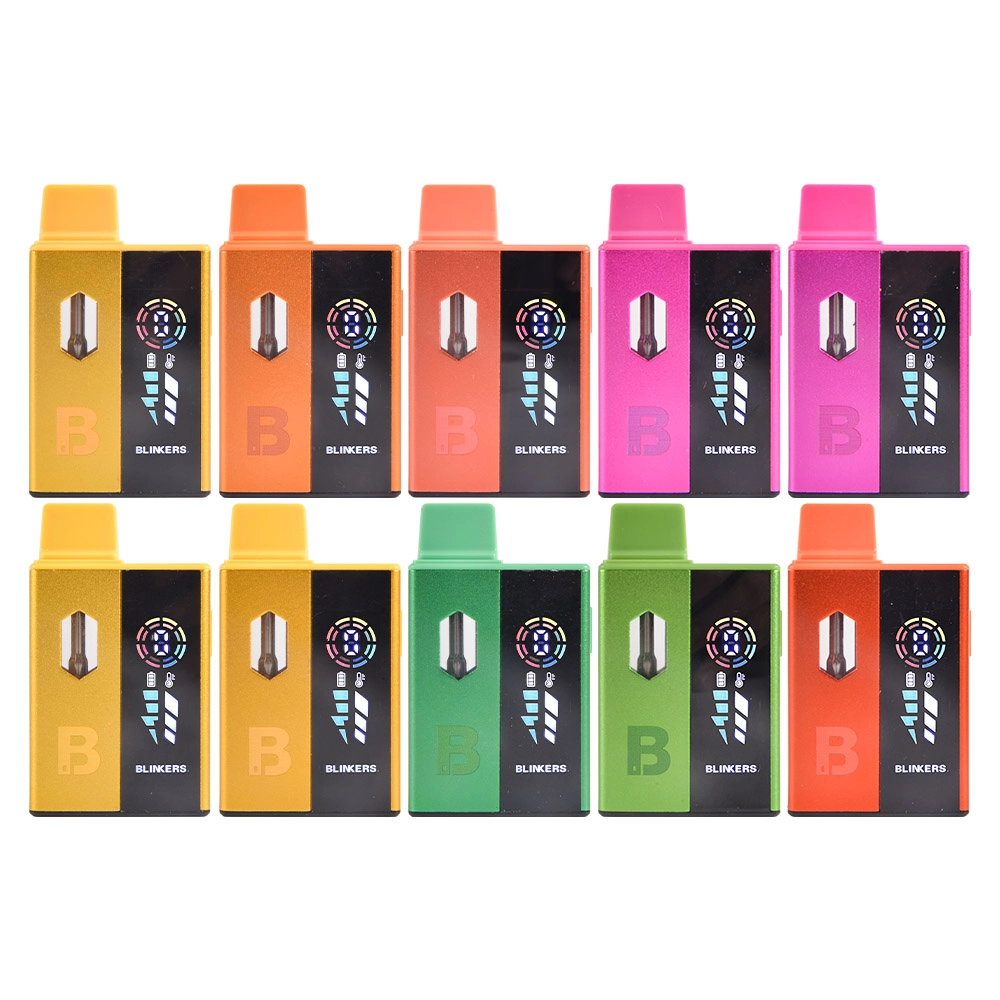
In the cannabis vape world, Blinkers is now almost shorthand for big-capacity, hard-hitting disposables. Pre-filled Blinkers devices often come with 2 g or more of high-potency oil, rechargeable batteries, multiple voltage modes and pre-heat functions, positioned as a premium all-in-one pen for heavy users.
For licensed processors, white-label brands and filling labs, however, the opportunity is not in buying finished consumer pens, but in sourcing Blinkers empty disposable vape hardware—“shells only” that you can fill, cap and package under your own compliant brand.
This guide explains what that actually means, how the market is evolving, and which technical and compliance boxes your hardware should tick in 2025.
1. Why Blinkers-Style Empty Disposables Are in Demand
Cannabis vaporizers are one of the fastest-growing segments in the legal market. Recent industry analysis estimates the global cannabis vaporizer market at around USD 5.7–6.5 billion in 2024–2025, with forecasts pushing it towards ~USD 21 billion by 2034, a compound annual growth rate above 14%.
Within that, vape cartridges and disposables are a major sub-category. One report sizes the global vape cartridge market at USD 1.8–1.9 billion in 2024, projecting growth to roughly USD 6 billion by 2030, with a CAGR of more than 20%. Disposables—especially 2 g and 3.5 g formats—have captured consumers who want:
-
No separate battery to screw on
-
Large capacity in a pocket-friendly device
-
Strong, consistent hits from ceramic-coil technology
Blinkers-style pens sit exactly in that sweet spot: typically 2 g+ oil capacity, rechargeable batteries, button or auto-draw activation, and configurable voltage or pre-heat modes.
For a B2B buyer, Blinkers empty disposable vape hardware lets you offer the same type of user experience—with your own oil, strain lineup and branding—without being locked into someone else’s finished product.
2. “Blinkers” as a Brand vs. “Blinkers” as a Vaping Behavior
There are two overlapping concepts you should keep straight:
-
Blinkers as a brand – A premium disposable line widely marketed with 2 g and 3.5 g devices filled with high-THC oil, often featuring rechargeable batteries, multiple voltage settings and pre-heat.
-
“Blinker” hits as a behavior – In the broader vape community, a “blinker” also refers to inhaling until the device light blinks, meaning you’ve reached the maximum allowed puff duration, usually around 8–10 seconds on many pens.
When we talk about blinkers empty disposable vape in a B2B context, we mean:
Hardware that matches the capacity, performance profile and safety features consumers expect from Blinkers-type disposables—but sold as empty devices only (no oil, no nicotine, no THC included).
Your customers care about the brand experience; regulators care that what you sell is safe, tested and properly labeled. Hardware that behaves predictably (including how and when it “blinks” to cut off a long draw) is part of that equation.
3. Empty vs. Pre-Filled: Why Hardware-Only Matters
For licensed labs and brands, choosing empty hardware instead of pre-filled pens offers several advantages:
-
Full control over formulations
You decide cannabinoid ratios, terpene blends, viscosity and cutting agents (if any), aligned with local regulations and your internal safety standards. -
Brand differentiation
Even if the form factor is Blinkers-style, your artwork, strain names and compliance labeling stay front and center. -
Supply-chain flexibility
With a trusted partner supplying blinkers empty disposable vape hardware, you can scale filling runs up or down independent of any one finished-goods brand. -
Regulatory clarity
Hardware-only suppliers (like Vapetech420) focus on device testing, battery safety and packaging compliance, while you handle licensed cannabis manufacturing. That clean split can make audit trails simpler.
From a compliance perspective, you should always ensure that any oil you fill is produced, tested and labeled in line with the applicable laws in your jurisdiction. The empty hardware itself still has obligations—especially on the battery and transport side.
4. Key Specs to Look for in Blinkers Empty Disposable Vape Hardware
When you source Blinkers-style empties, make sure the spec sheet isn’t just marketing language. At minimum, serious B2B buyers normally check:
4.1 Capacity and Oil Compatibility
Most Blinkers-type pens on the market are 2 g disposables, with some lines extending to 3.5 g.
For your blinkers empty disposable vape hardware, confirm:
-
Actual tank capacity (e.g., 2.0 ml vs. 2.5 ml vs. 3.5 ml equivalent)
-
Viscosity range the device is designed for (high-THC distillate, live resin, rosin, etc.)
-
Tolerance for different terpene percentages and solvents
A good vendor will be able to share lab filling curves, failure rates and recommended filling temps from pilot runs.
4.2 Ceramic Coil and Resistance
Modern premium disposables nearly always use porous ceramic coils rather than cotton wicks, aimed at:
-
Better flavor stability over a long-capacity tank
-
Lower risk of burnt hits
-
Compatibility with thicker concentrates
You’ll typically see resistance around 1.2–1.4 Ω for Blinkers-style devices, tuned for smooth vapor at moderate power rather than extreme cloud chasing. Ask for coil material details and internal testing data instead of just accepting “ceramic” on the spec sheet.
4.3 Battery, Rechargeability and “Blinker” Cut-Off
Blinkers-style pens usually pair a rechargeable lithium-ion battery with a time-limited puff window—that’s what causes the light to blink when someone takes a very long draw.
For empty hardware, check:
-
Battery capacity (mAh) and estimated total puffs per full tank
-
Recharge port (USB-C is increasingly expected)
-
Puff time-out (e.g., 8–10 seconds) and LED feedback patterns
-
Protection features: over-charge, over-discharge, short-circuit and over-temperature cut-offs
These are not “nice to have” features anymore; they are part of basic due diligence.
5. Safety and Compliance: UN38.3, IEC 62133-2 and Transport Rules
Because Blinkers-style disposables use rechargeable lithium-ion cells, the hardware must respect the same safety regime as other battery-powered electronics.
5.1 UN38.3 Transport Testing
Almost all lithium batteries shipped by air, sea, road or rail are expected to pass UN Manual of Tests and Criteria, section 38.3. This test series simulates altitude changes, temperature cycles, vibration, shock, short-circuit and other worst-case transport conditions to verify cells are safe to ship.
Regulators (and carriers) now require a UN38.3 test summary to be available from manufacturers and distributors; aviation guidance updated for 2025 emphasizes that this applies across lithium-powered devices.
If your blinkers empty disposable vape hardware doesn’t have a proper UN38.3 report, that’s a red flag.
5.2 IEC 62133-2 and UL 62133
For rechargeable lithium-ion cells in portable devices, IEC 62133-2:2017 is widely recognized as a core safety standard, addressing electrical abuse, mechanical shock, vibration and other hazards.
Many reputable battery and device makers either:
-
Certify cells directly to IEC 62133-2, or
-
Use UL 62133, which is harmonized with IEC 62133-2 in North America.
For B2B buyers, that means:
-
Asking for test certificates or reports (not just a logo in a PPT)
-
Confirming that the exact cell model inside your Blinkers empty disposable vape is covered
-
Ensuring that your own packaging and transport practices stay aligned with these standards
6. Regulatory Pressure on Disposables: Why Quality Matters More Than Ever
Regulators in multiple markets are increasingly focused on disposable vape waste, youth access and unauthorized products. For example, recent analysis in the U.S. estimated that unauthorized flavored nicotine disposables in convenience channels still accounted for billions of dollars in sales in 2024, even after aggressive FDA enforcement against many popular brands.
In the UK, research suggests more than a million vapes are discarded daily, contributing to serious environmental and battery-fire risks, and helping drive policy moves toward banning single-use vapes and tightening producer-responsibility rules.
Even though cannabis hardware is a separate category, the political pressure around all disposables means your brand cannot afford failures, leaks, swollen batteries or devices that show up without basic battery documentation.
Choosing blinkers empty disposable vape hardware from a supplier that can demonstrate:
-
Robust battery and device testing
-
Proper UN38.3 and IEC 62133-2 documentation
-
Consistent QC on tank seals, airflow and tolerances
isn’t just about “premium feel”—it’s about risk management.
7. How Vapetech420 Positions Blinkers-Style Empty Hardware
For a site like Vapetech420, the value proposition around blinkers empty disposable vape hardware is simple:
-
Hardware-only focus – Devices are supplied empty, with no oil, nicotine or THC included. You use your own licensed facility and formulations.
-
Spec-driven sourcing – Capacity, coil type, battery protection and fill performance are treated as engineering questions, not just marketing claims.
-
Documentation-ready – UN38.3 test summaries, battery safety standards and packaging specs are prepared to support your own compliance and logistics teams.
As the cannabis vaporizer market continues to expand, B2B buyers who take hardware selection seriously will be in the best position to build long-term, trusted brands. A well-specified Blinkers-style empty disposable isn’t just another device—it’s the foundation of the experience your customer will remember every time the LED blinks.
If you want to more vape wholesale pls go through these pages:empty disposable vape|2 grams disposable wholesale
0 Comments